DSC_7617

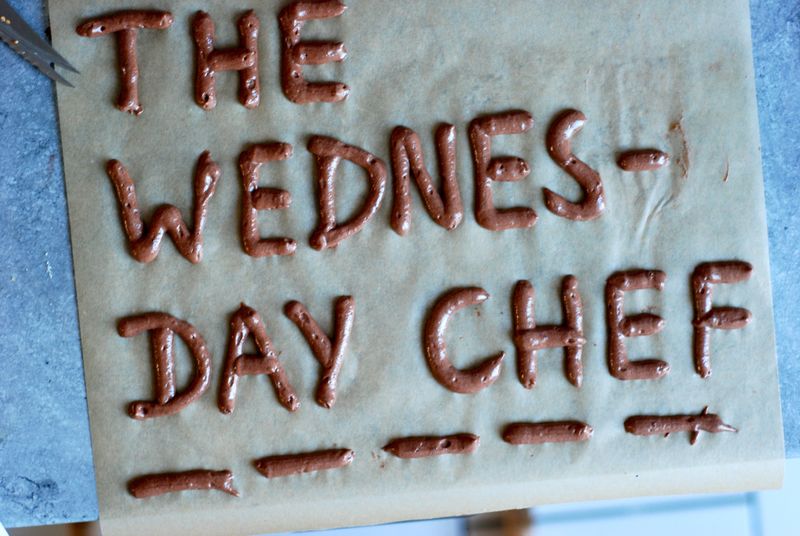
Maja has a way with a piping bag! These cocoa-flavored meringue cookies are called Russisch Brot and are really crisp and not too sweet. Great for little children, and snackers of all ages.

Thank you so much for all of your amazing questions about writing Classic German Baking, both here and on Instagram! I'm going to answer a whole bunch in this post and then I'm going to go into more detail on other questions in subsequent posts. This is a pretty long one, as is, so get yourself a hot drink and get settled.

Actually, before I get started, because there seems to be some confusion about this in some corners: Classic German Baking is being published by Ten Speed Press, which is an American publisher. The book is in English. If we are lucky, foreign publishers may buy the foreign rights, in which case it will get translated into other languages.

Okay, let's start with the easy questions:

Bethia asked:
"Is there a release date planned yet? Hoping we'll have the book in time to make the lebkuchen dough."

The book will be published on October 18, 2016! So you'll definitely have cookies in time for Christmas.

Dani asked:
"
Will the book use cups, ounces or grams?"

The book is being published with both metric and Imperial measurements.

Carla asks:
"What are you suggesting as an American substitute for Quark?"

I don't suggest a substitute, but I do provide a very simple recipe in case you can't find Quark near where you live. The Quark I've seen in the US is much looser and creamier than German Quark, so it requires some straining before use in baking. If you make your own, you can control the level of moisture in the Quark very easily. I've heard that using nonfat Greek yogurt in place of Quark can work in some recipes, but we can't get that here and anyway, I prefer to use the real thing, especially since making your own Quark is so easy and fun. However, if there are any volunteers out there who want to attempt one of my Käsekuchen (cheesecake) recipes with nonfat Greek yogurt instead of Quark for me sometime in the next week, let me know in the comments!

Jenny asks:
"I am wondering if you will also have recipes for breads to make in bread machines? We got a fantastic bread machine which we use 3 times a week. Also, will your book have recipes w/alternatives to wheat flours, such as rice, quinoa, millet, buckwheat, teff, chickpea etc."
 
I don't have a bread machine and I'm not familiar with them at all. However, almost all of my yeasted recipes use instant yeast, which is also known as bread-machine yeast, so I think that with some tweaking, you'll probably be in business. Since this is a book about traditional German baking, the most "exotic" flour you'll find in the book is buckwheat flour, which is used in a delicious whipped cream torte. There are a few regional recipes that require white spelt flour, and of course there are many recipes that use a mix of rye and wheat flours. It was very important to me that this book deliver a solid collection of classic recipes made exactly the way German bakers make them, and producing results that any German grandmother would be happy with.

DSC_7762

The dark horse of the book, Sachertorte, which is, as I wrote in the headnote, something I always thought was sort of a dusty old thing that tourists go to Vienna to eat and secretly find slightly disappointing, but then I dove deep into Sachertorte development and discovered that it is actually the only cake I would like to eat on my birthday for the rest of my life. It is BEYOND. It was also one of two chocolate birthday cakes that I made when Hugo turned 3 last June, the lucky little boy, hence the hippo(?)-shaped candles above. The surface of the cake is not normally supposed to look that lumpy, but we didn't have puréed apricot preserves that day…tsk tsk!

Now let's get into the nitty-gritty.

Lindsay asked:
"Are most of the recipes things you have always loved to make or recipes you tried and developed specifically for the book? Did you have any total flops? Does the publisher also test the recipes? How much of a say do you get in things like the cover photo and overall look of the book?"

There are close to 120 recipes in the book. Some are ones that I have been making and/or eating since I was a small child and those recipes were passed on to me by close family friends and then tweaked until I was happy with them. Many more are classic German recipes that are largely very well-known here nationally or regionally and that I developed based on a ton of different sources and a good amount of my own taste. Because Maja and I sourced our recipes from all over the place – ancient cookbooks, contemporary ones, the Internet, friends and family and so on – there were plenty of flops during the testing phase. I remember with particular distaste a hideously over-egged lemon cake, a flat and greasy almond-quark cake, and a grainy and leaden chocolate Gugelhupf. Gah! And then there were many more recipes that weren't outright flops, but just not good enough to make it into the book. We, to put it lightly, ate a lot of cake (and cookies and bread) over the past 18 months.

The publisher does not officially test the recipes – as with most publishers, in the United States at least, the author has the responsibility to provide well-tested recipes. But my editor and some of her colleagues have baked several recipes from the book so far in their free time and have been very happy with the results. Yay!

As for the last question, I am part of the decision-making process for the look of the book, exterior and interior, but it is very much a group effort. Each department, so to speak, has a say: sales and marketing, design, obviously, editorial, and me. It's collaborative.

Joy asked:
"Sounds like you've thoroughly tested the recipes in Germany, but my understanding is that US butter, flour, etc taste and bake differently than European ingredients. What will be your process for testing these recipes with US ingredients?"

Over the many years that I've been baking here in Germany, I've used standard German 405 or 550 flour for American all-purpose flour and the results in my cookies and cakes baked from American recipes have always been just right. So when I started testing recipes for the book, I stuck to using those flours as much as I could and am pretty pleased with the reports I've been getting from my testers in the US and from the recipes I tested myself on recent trips to the States. German butter, like all European butters, is higher in fat than US butter so I note in the book that, if possible, you should use imported butter that has a higher butterfat content, especially in recipes where butter is a starring ingredient. But all of the recipes in the book will also work just fine with standard American butter.

German baking replies heavily on fresh yeast, which can be tough to find in the US (though I hope this book changes that!). It makes for exceptionally puffy and delicious yeasted goods. When I could justify not using fresh yeast in a recipe, I called for instant yeast, which is the same in Germany as it is in the US, where it is also known as bread machine yeast. (Active dry yeast does not exist here in Germany and does not work reliably, in my opinion. So I have many warnings throughout the book not to use it.) However, German baking powder works differently than American baking powder, so I have a large supply of American baking powder here in Berlin which I used to test the entire book (I also use it for any other baked goods I make). Same goes for vanilla extract – I buy it in the US and then keep a stash here which I use every time I bake. In other words, the book was written largely for the American baker and the recipes should all work as written. One caveat, of course, is that depending on your location and the temperature and humidity of your location, your doughs may require a tiny bit more moisture or flour. As you learn to work with yeasted doughs, you'll learn to recognize if they need a few drops more water or milk, or another sprinkling of flour.

Laura asked:
"As a fellow writer, I'd love to know what the process was like collecting and narrowing down particularly "German" recipes, and for particularly for you, someone who has had many 'homes,' including Germany, what that felt like."

Luckily, German baking, while a vast, vast subject, has its clear mega-hits, so I always knew that the book would have to include a lot of things, like Schwarzwälder Kirschtorte or Linzer Torte (which is Austrian, to be precise), for example, that I didn't grow up with personally, but that were sort of archetypal and essential to the book. Because German baking is such a thing, for lack of a better word, and in no place more strongly than right here in Germany, it wasn't particularly difficult to collect recipes. In fact, we could have easily made the book twice as long as it is. Narrowing down the recipes to include was something I did largely based on my own taste. For example, I'm not a huge fancy cake or torte person, so I edited the selection of those for the book quite carefully, while I absolutely adore yeasted cakes and could rarely keep myself from slipping one more recipe in. Several of the recipes I've grown up with, like Springerle, Basler Leckerli, and Pflaumenkuchen, were included not just because of nostalgic reasons, but also because they are just so good.

I relied a lot of Maja's input, of course, which was invaluable, but also on the taste of trusted friends and bakers, who insisted, for example, that Franzbrötchen, squashed cinnamon buns, a regional specialty from Hamburg, or Streuselschnecken, iced streusel-topped sweet buns, be included. Then I spent a lot of time thinking about what American readers would be interested in making, what would be challenging to them, or comforting, or a revelation. That led to me including a recipe for standard white breakfast Brötchen, because everyone who visits Germany raves about them, to an aged Lebkuchen dough, to illustrate how entrenched baking traditions are here, just to mention two. It's really important to me that this book educate, illuminate and explain certain aspects of German culture, as well as food traditions, because I think that providing cultural context is really crucial when it comes to food. And then there were the fun decisions, based solely on deliciousness and ease of preparation. The slam dunks, so to speak. Maja and I both fondly remember those many happy moments when we first dug into something freshly baked and it felt like the heavens were opening up as we ate. Those were the easiest things to include and the ones we're still making on a regular basis, like the best Marmorkuchen (marble cake, Maja's family's recipe) I've ever had and my beloved Gugelhupf.

It was important to me to include regional specialties too, so we did a lot of delving into regional cookbooks and websites for inspiration. I hope the book reflects an interesting cross-section of German baking for people who are totally new to the subject, but also to old pros.

Carmit asked:
"I'd love to hear about the editing process, particularly the developmental edit."

On the manuscript due date, I sent off the file via email to my editor. Then I stared in stupor at a wall for about an hour. No joke. It took me about four days to bring myself to open a bottle of bubbly to celebrate, I was just so drained. While I worked on celebrating my hard work (or lying sleeplessly in bed at night freaking out about some recipe that I should have included or some wording that suddenly seemed really wrong), my editor worked on the manuscript for several weeks, marking it up with questions and comments both big and small. (Like, "Why do you require a timer for this here but not there?" or "I hate raisins! :)" or "Let's move this long digression on the difference between East German poppy seed fillings and West German poppy seed fillings to page XYZ".) When her developmental edit was done, I got the manuscript back and had a few more weeks to work on answering her questions, accepting or rejecting her changes and adding last-minute recipes that either occurred to me or to her (pretzels!). I also feverishly tested several more recipes and incorporated those changes. When that was finished, the manuscript went back to my editor who looked over everything and then passed it on to the copy editor.

Right now, I'm waiting to get the manuscript back from the copy editor so that I can find out just how many times I wrote "poppyseed" instead of "poppy seed" and how many instances of the conversion of the weight of ground almonds from Imperial to metric are not entirely accurate. Welp! This is the nit-picky part of the editing process, where one lives in terror of a mistake slipping through or an inconsistency not being caught and one has fever dreams about hordes of angry Amazon reviewers tearing your carefully written book to shreds in less than a year's time. Good times, in other words! When I'm done working through the copy edit, the manuscript goes back to my editor who will then have someone input all the final changes before sending the file off to design, which will convert that final Word document into the design program and pair my words with the photographer's images. After that, the thrilling moment of seeing first pass pages awaits (in other words, seeing the book laid out in designed pages and no longer as an old, black-and-white Word document).
DSC_7156

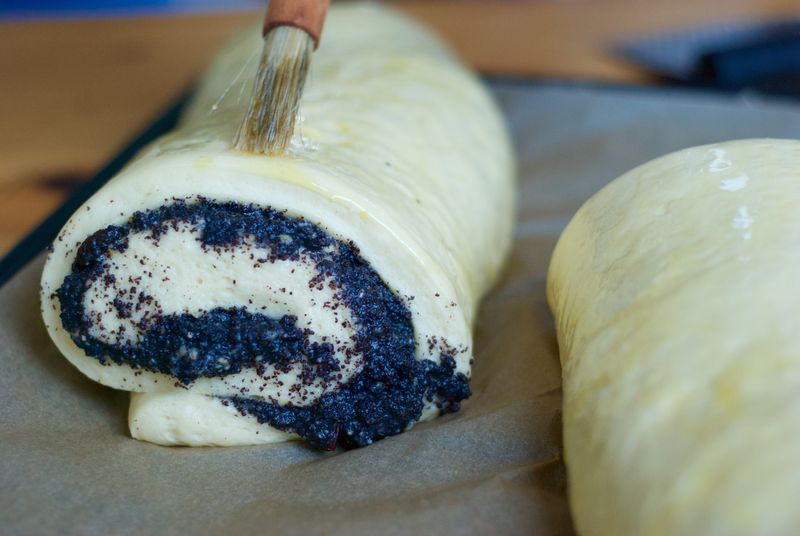
Round 1 of the Silesian poppy seed roll, getting brushed with butter. I think this may be one of the most-tested recipes in the book, even though it was pretty great right from the start. I just can't quit it, I guess. In fact, it's on the docket for next week again.

And finally, from Instagram:

From @awhofsy: "Do you give the recipes to other people to test?"

Yes! Many, many other people! Maja and I made most of the recipes in the book multiple times, both together and separately, but I had dozens of testers in the United States working on the recipes as well. Still do, in fact.

From @maitlowe: "What were the easiest, hardest and most rewarding parts of writing the cookbook?"

The easiest thing was having Maja in my kitchen. I'm pretty particular about who I share my kitchen space with, but Maja and I fit together right away. In fact, I got so used to having her around that now when I'm working in the kitchen alone, I feel an actual empty space where she's supposed to be. The hardest thing was getting started. The project seemed so huge and insurmountable at first that it took me quite a bit of time just to jump off the springboard. The most rewarding thing has been reading through the manuscript now that it's almost completely done and feeling deep in my belly that I'm so proud of how the text of the book has turned out. As I mentioned in the previous post, I actually want to own and bake from this book forever, even if it hadn't been written by me.

From @_emilywenzel: "Did you ever perfect your Stollen recipe?"

This is the only question to which I will give the following answer: You'll have to buy the book to find out! 🙂

Posted in

63 responses to “Classic German Baking Q&A, Round One”

  1. Carmit Avatar

    Thanks for answering my question!
    And I know the answer to the Stollen question, but my lips are sealed ;).

    Like

  2. Christie @ A Sausage Has Two Avatar

    Such an interesting post, thank you so much for giving us an insight into the whole totally exhausting-sounding process. I am very excited that you are publishing something that’s going to show people how much more there is to the sweet side of the German cuisine 🙂 Best of luck with the next stage!

    Like

  3. Alice Adams Avatar
    Alice Adams

    I would love to test the Kaesekuchen with non-fat Greek yogurt for you this weekend. My cousin and I already have a cooking weekend planned. Send me a note with the instructions and we will tackle it for you!

    Like

  4. Jennifer Jo Avatar

    I’ll do a Greek yogurt/Quark test for you! We have a snow storm coming, so it’s the perfect time for baking. (Heading to the store in a few hours, so give me a holler if there are unusual ingredients I need to purchase.)

    Like

  5. jemima Avatar
    jemima

    Thanks for doing all this work so we don’t have to! Can’t wait for the book.

    Like

  6. Stefanie Avatar
    Stefanie

    I had great results substituting quark with labneh. It is slightly more tangy but the consistency is right and it does not require straining. And since you know Boston: Russo’s in Watertown carries it and of course you can find it in any of the Armenian shops in Watertown.

    Like

  7. Maria Avatar
    Maria

    Let me preface my question by saying that I do not intend to ask this with any mean spiritedness, it is a genuine question. What makes you qualified to write a book on German baking? Or in other words, what is the “angle” of the book? I don’t think it matters that you aren’t German–many people have written excellent books as non-natives. But the angle of your blog hasn’t been predominantly focused on baking–compared to say, Apt 2B Baking Co. or Joy the Baker, etc. And with the exception of your Berlin restaurant scene blog, your blog hasn’t really been about German cuisine either. Based on your 2014 blog post announcing how this cookbook came to be, it also doesn’t seem like it was something that was the result of many years of research (like, for example the books of Naomi Duguid or Paula Wolfert). So I guess my question is why German baking, why now, and what is the angle?

    Like

  8. Gerlinde@Sunnycovechef Avatar

    Luisa, really, I can’t wait for this beautiful book. It is something that I have been waiting for. I think you are super qualified to write this book because you live in Germany and have lived there most of your life. You are a great writer and cook. You have been writing about food most of your adult life. The recipes on your blog have been hits all the time. I have made a lot of them. What qualified Julia Child to write about french cooking? I think you are going to be the Julia Child for German cooking. I hope you promote your book here in Sanata Cruz. When you start thinking about the second book I will send you a bunch of recipes that the women in my village put together years ago. I have one question , is a recipe for Mandelhörnchen in your book?

    Like

  9. Gerlinde@Sunnycovechef Avatar

    Here in Santa Cruz I can buy Apple Farms Quark in my grocery store.( http://www.apple-farms.com Telefon: 360-384-4996) . In the Bay Area Oakdale Cheese is selling Quark at the different Farmer’s Markets. ( www. oakdalecheese.com)

    Like

  10. Katharina Avatar

    So excited for this!!! I have all of my German recipes (including a must-bake-every-year aged Lebkuchen recipe) but not only can’t I wait to try yours – my daughter will be so happy to have everything in Imperial measurements and all of these recipes in one place!!! I have so many friends who will be getting this book so that I can stop translating my recipes….do you give a discount for buying in large quantities? Thank you so much for creating this book!

    Like

  11. Emily Douglas Avatar
    Emily Douglas

    It so nice having you back here, Luisa! I think we have all been eagerly awaiting this book for awhile (and will continue to do so). I’m so glad you’re giving us a peek into the process as well. If you do need another tester, please let me know!

    Like

  12. Jean Connor Avatar
    Jean Connor

    I am so excited about this book! I lived in Germany for 6 years, and I am a baker. When I would ask my Deutsch friends about recipes for breads, etc., they would say, “Why would we bake? There are bakeries everywhere!” This didn’t help me
    much when I came back to the US.
    I would be happy to test any recipes for you. I live in Texas, and Central Market does carry quark, but I also use Greek yogurt a lot. Just let me know.
    I love your book, I love your blog. Makes me kind of “homesick”.

    Like

  13. Caroline Avatar
    Caroline

    This looks so lovely. I’m excited about the poppy seed everywhere-ness! My mother who is Ukrainian, was the youngest daughter and never learned her mother’s poppy seed baked goods recipes. I’m hoping one or more of the ones in your book will work for her.
    Also, since I live at altitude (6,700 feet or 2,042 m), will you be including any adaptation to altitude baking hints? Since parts of Germany and Austria are at even higher altitude did you have to adjust any recipes for lower altitude (Berlin) baking? Anyway, good luck on the last stages of publication!

    Like

  14. Amelia Avatar
    Amelia

    I would love to test the Kaesekuchen with greek yogurt!

    Like

  15. Tina Avatar
    Tina

    I have been reading your blog since you lived in New York and I in the south of Germany and now I have been living in Bayerisches Viertel for almost 7 (!) years, with a now three year old child 😉 I love seeing familiar places on your instagram feed and have followed your Berlin on a Platter lead many times but have never commented so far I think.
    To cut to the chase I have to say: Despite being a German with a lot of cookbooks and family recipes, I have known since you started posting pictures on instagram that I HAVE TO HAVE THIS BOOK!

    Like

  16. Allyson Avatar

    I can’t wait to read this cookbook. And if you’re still looking for Greek yogurt Käsekuchen testers I’m all in.

    Like

  17. Luisa Avatar

    The “angle” is actually right there in the title. The book is a collection of classic German baking recipes, with a few Austrian and Swiss ones thrown in because of their importance in German culture. The “why”: There is no classic German baking book on the American book market (or the English one, for that matter), with the exception of branded Dr. Oetker ones. In fact, all the way back when I was a cookbook editor in New York, this gap was widely noticed by cookbook editors, including me. So this book will fill that hole. I’m so happy about that. German (and Austrian) baking is arguably the foundation of much of America’s favorite baked goods, from doughnuts to Danish to coffeecake and so much more and I’m eager to share all that information, all those delicious recipes, and all those interesting traditions with the American baker (and hopefully beyond). As for me: Not only was I born and raised in Berlin, eating and baking many of the classic German baked goods that this book features, but I’ve spent the past six years here as a food writer, doing research into many of the traditions and recipes I write about in the book (and touched upon in my first book, which was published in 2012). My publisher approached me about writing this book because he felt that I was uniquely suited for it, being both intimately familiar with German baking and experienced with the American cookbook world and what American bakers need from their recipes and might be interested in attempting. I’m so glad he did.
    And I just have to add that while you say you don’t mean to be mean-spirited, comparing me unfavorably to other writers and implying – incorrectly – that this book isn’t the result of years of hard work and research isn’t what I’d call nice.

    Like

  18. Luisa Avatar

    Thank you, Gerlinde! I so hope to come back to Santa Cruz! I would love those recipes. And yes, there’s a recipe for Mandelhörchen. 🙂

    Like

  19. Luisa Avatar

    Thanks for your awesome enthusiasm, Katharina!

    Like

  20. Luisa Avatar
  21. Luisa Avatar

    Aw, thank you so much.

    Like

  22. Luisa Avatar

    I’m afraid I don’t have any altitude tips. Is there maybe a general resource online for adapting baking recipes for high-altitude? The Alpine recipes we made in my Berlin kitchen turned out just fine.

    Like

  23. Luisa Avatar

    You are my neighbor, then! Thank you so much for your enthusiasm and I hope we run into each other sometime in the neighborhood! 🙂

    Like

  24. Luisa Avatar

    Fantastic! Thank you.

    Like

  25. Michelle Avatar
    Michelle

    Congratulations Luisa! I’d also be happy to test out the Käsekuchen with nonfat Greek yogurt!

    Like

  26. Skye Avatar
    Skye

    Luisa, I’d be very happy to try out your kasekuchen with greek yoghurt. I love cheesecake!!
    Please let me know. Thanks, Skye

    Like

  27. Heidi Avatar
    Heidi

    Congratulations! Pictures! Do all your recipes come with a picture?

    Like

  28. Adina Avatar
    Adina

    Congratulations Luisa, I am so getting this book the moment it is sold here in Germany. I was a bit shocked that there is a difference between German and American baking powder. It never occured to me that there is one, but it definitely explains some fails I’ve had when baking American recipes. Sometimes they work although I substitute 1:1 but sometimes they just didn’t, and I end up with some heavy, kind of wet cakes and me thinking about the weird things Americans like…. It would be great if you had some tips about a good substitution. Thank you.

    Like

  29. TJ @ MyBookStrings Avatar

    I am eagerly awaiting this book! I have been grappling with trying to convert my German recipes to work right here in the US, and I am counting on this book to solve all my problems. Oh, to be able to bake a Stollen the way my grandmother used to make…

    Like

  30. Cake Delivery in Hyderabad Avatar

    Beautiful Post! Thanks for sharing such an amazing information.. I really enjoyed my stay here..
    Keep Posting..

    Like

  31. mcc Avatar
    mcc

    Clock Shadow Creamery makes quark here in Milwaukee, WI (a city with serious German heritage). It is sold in stores locally, including Whole Foods, but the creamery also ships quark, if you’re having trouble finding it in your area: http://www.clockshadowcreamery.com/index.php/where-to-buy/ and http://www.clockshadowcreamery.com/index.php/gift-boxes/

    Like

  32. Susan B Avatar
    Susan B

    Really looking forward to this, even though I’ve all but stopped buying cookbooks. It will share shelf space with SWEDISH CAKES AND COOKIES, arguably the other pillar of American baking traditions.
    I have become mildly addicted to the poppy seed cake at Kaiser Biobakerei in the Frankfurt area, because it’s way less sweet than others I’ve tried. Do you have something like that to look forward to among your pages?

    Like

  33. Carmen Berthelette Avatar
    Carmen Berthelette

    Luisa, I’ll be buying this book for myself and for all the bakers on my list. (next year’s Christmas presents taken care of!) I have a quick question: Am renovating my kitchen this year. You had an induction cooktop in your last flat and have gone to gas in the present place. Which is your favorite??
    Thanks!
    Carmen

    Like

  34. Luisa Avatar

    I didn’t have induction in the old place, just an electric cooktop. I got used to it after hating it at first, but still much prefer gas. I’ve cooked on induction and like it, but am a creature of habit, so I prefer gas. I think, ultimately, it depends on what you get used to… Hope this helps!

    Like

  35. Nick @ Bakingbeardy Avatar

    Really excited – especially now that you’ve mentioned the high butterfat content – sounds like it will be perfect with my Irish butter!

    Like

  36. lisa Avatar
    lisa

    I would love to bake a cheesecake with 0% fat greek yogurt. Where can I find a recipe to try?
    I am sooooooo looking forward to your book, I have devoured any related photos on Instagram and got excited – I can’t wait until October, I don’t want to do another Christmas without your book! xxx

    Like

  37. Luisa Avatar

    I found enough testers, but thank you!

    Like

  38. Happy Mum Avatar
    Happy Mum

    Very exciting — the recipes sound lovely — I’m really looking forward to this cookery book. Two thoughts now. (1) I think “Imperial measurements” (used in the UK and Commonwealth countries before they went metric) are not exactly the same as “US measurements”. For example, an Imperial pint has 20 fluid oz, whereas a US pint has 16 fluid oz. I’m guessing that “Classic German Baking” — aimed at a US audience — uses US rather than Imperial measures…? (2) The question from Maria about “why German baking, why now, and what is the angle?” might have been a bit clumsy or blunt, but it doesn’t seem unreasonable or mean-spirited, just honest and curious — (perhaps other people will want to know more about this as well, eg in future PR) — and you answered it thoughtfully and informatively — well done.

    Like

  39. Charlotte Avatar
    Charlotte

    Hi Luisa, I’m so excited by the prospect of having this book to bake with in my Canadian kitchen. If you need a Canadian baker I would love to test for you (I imagine you already have scores). I am looking forward to baking things and am hoping I recognize some of the goodies I ate as a child living in Germany (when my dad was posted there) but that I never really knew the names for – well I do know tostbroten (sp!!) as I used to go to the bakery to order it for my mum.

    Like

  40. Katie Avatar

    Yay! I can’t wait for this one. My mum gifted “My Berlin Kitchen” to me while we were in Berlin for a quick trip, and it became my most prized possession when my flights were delayed…
    Sounds like you already have more than enough recipe testers, but I have lots of Greek yogurt in my Ottawa fridge and would be happy to try it out in this neck of the woods. Cheers!

    Like

  41. Anne Avatar
    Anne

    I’ve loved reading about the recipe development, I’m excited to make some of your recipes in the fall! One question that occurred to me often is how you managed all the leftover finished cakes and desserts? Do you accept that as a casualty of testing going in?

    Like

  42. Carla Kremer Avatar
    Carla Kremer

    The Whole Foods in Westminster CO carries a Quark but it would be cost prohibitive to buy enough to make a Kaesekuchen. I’m waiting for the results of the Greek yogurt trials. I have been able to bring back Quark from Germany without any problem but again, not enough for a cake. When we lived in Germany, my husband used to joke that he was only businessman with a suitcase full of American flour when he traveled back from the US.

    Like

  43. Luisa Avatar

    The book has a recipe for making your own Quark at home, which is the best option. This is the same method that people used in the past in Germany to make Quark. The Greek yogurt trials aren’t promising – and certainly not for recipes in which Quark plays the starring role.

    Like

  44. Kristin Avatar

    I lived in Berlin for 5 years and NOT ONCE did i get a baked (German) good i liked…but i’m wierdly intrigued by this book! Granted I lived in neukölln and most bakeries there are späte equivalents or hipster owned overpriced mediocrity!

    Like

  45. Nadia Avatar
    Nadia

    Ten Speed Press publish wonderful baking books, I’m not surprised you’ve joined their ranks. Congratulations, I can’t wait to see this book when it’s out!

    Like

  46. Kim A Avatar
    Kim A

    I just pre-ordered my copy of Classic German Baking by Luisa Weiss on Amazon. Can’t wait to get it.

    Like

  47. Luisa Avatar

    Whaaaaaa?!? Amazing! Thank you!!!!!!!!

    Like

  48. Jessica Avatar
    Jessica

    Thanks for sharing the process! I have a strong German heritage, but while there is a strong history of cooking in the family, the traditional German baking recipes were not made or passed along. I’m quite excited for your book to come out in the fall so I can see what I’ve missed out on! Will you be coming to the US for any book discussions/signings? Sorry if you mentioned this already and I missed it.
    ps – for any other blog readers in Iowa, Milton Creamery makes quark.

    Like

  49. Jeff @ Savvy Oven Cleaners Avatar

    Silesian poppy seed can also be found in Poland, in the region of Katowice! Lived there quite a while and had lots of Silesian meals and dishes. Quite an appropriate region for a foodie.

    Like

Leave a reply to Jessica Cancel reply