You spend 10 years in a city like New York and you consider yourself some kind of expert. You know how to get around the West Village without a map; every street corner means something particular to you; you start recognizing strangers miles away from the neighborhood from which you know them. That kind of thing. And then you leave.
The city, of course, goes on (as do you). Restaurants open and close, people move away, new buildings go up. And you start to hear about new places that would have been the kind of place you would have loved, if you still lived there. But you don't anymore. Nuts to you. Cue cravings for things you've never even had the pleasure of tasting.
One of these places for me was Saltie on Metropolitan Avenue in Williamsburg. I can't remember where I first heard about them; I think it was through Brian. But their sandwiches sounded totally beguiling. I mean, with names like the Captain's Daughter, the Scuttlebutt and the Spanish Armada, how could they not? Their funny names belied their aggressively straightforward composition, though: focaccia filled a slice of Spanish tortilla with aioli, focaccia swiped with hummus and piled with pickled vegetables; focaccia sandwiching scrambled eggs with ricotta. Every time I heard about Saltie, I got peckish, for sandwiches and for New York.
Luckily for me, Saltie published a cookbook, which I bought on my last visit to Boston in the fall. Saltie's pedigree is illustrious – the joint owners and chefs come from Diner, the now-famous restaurant that put Williamsburg on the map. They care about high-quality ingredients and have cheffy standards, but apply them to humble sandwiches, soups and cookies. Their book is a quiet delight – full of bossy instructions (I love bossy instructions) and musings on a variety of subjects, including herb salads and Moby Dick.
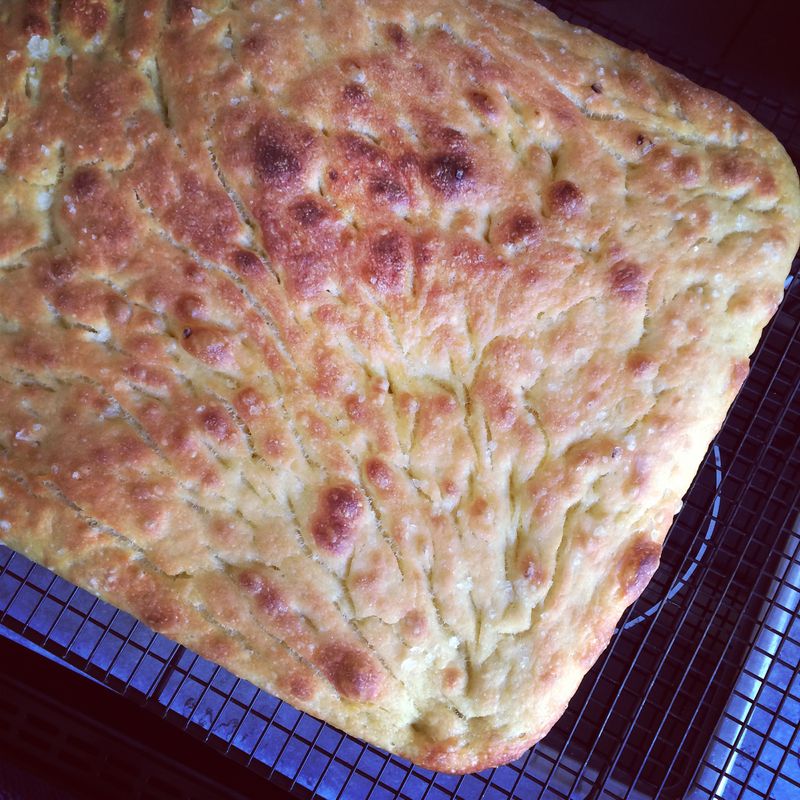
It also makes you want to cook things as disparate as chicken salad, pickled red currants and perfect boiled eggs. But the crown jewel of the cookbook has to be the recipe for focaccia, the basis upon which the whole Saltie operation stands. I made it when Adam and Craig came to lunch and it is, in my opinion, the holy grail of focaccia recipes (I'm talking about focaccia genovese, meaning a flat "loaf" of bread about the size of a baking sheet, baked with so much oil that it's almost fried – for thick and fluffy focaccia pugliese, click here).
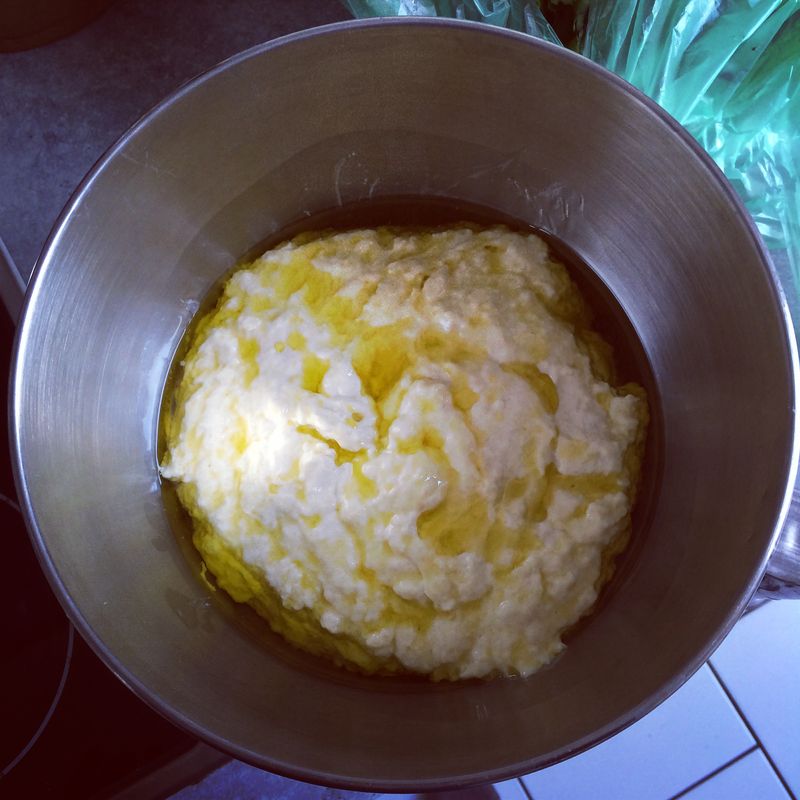
This kind of focaccia is the ultimate no-knead bread – you stir together flour, salt and yeast (the original recipe calls for active dry, which I don't like, so I substituted instant yeast, at a 1:1 ratio), then you add water and mix it all briefly with a wooden spoon until combined. You pour a substantial amount of olive oil in a big (big) bowl, dump in the batter, which looks more like milky oatmeal than bread dough, and put it in the fridge for a good amount of time (a minimum of eight hours; I let it go for 24). That's it.
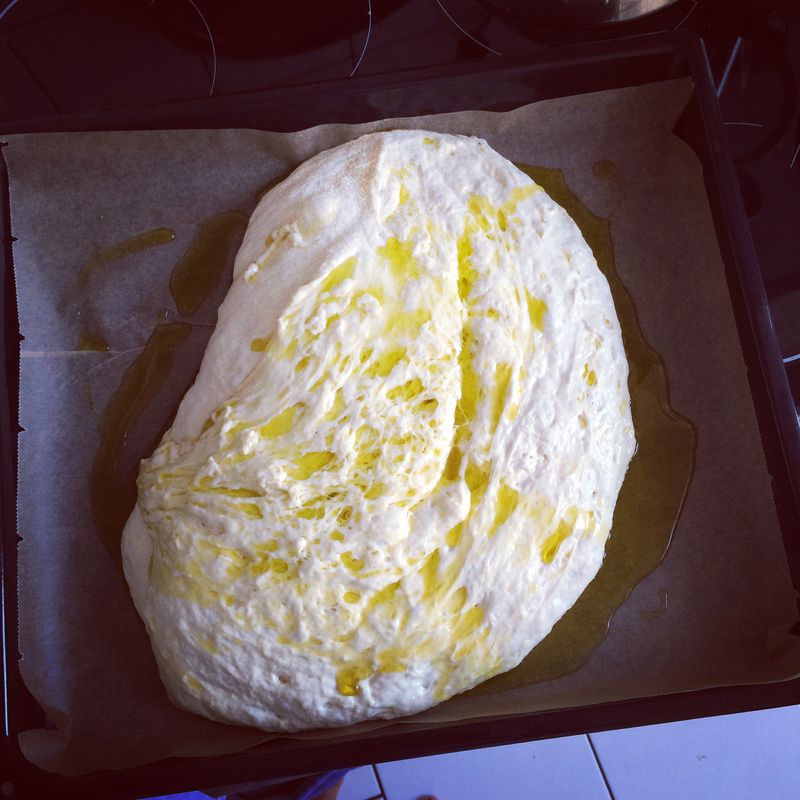
The next day, or when you're ready to bake, you simply pour the risen dough, which reminded me most of all of a soft and yielding post-pregnancy belly, onto a baking sheet and push it gently out to the corners. You let it come to room temperature, sprinkle it with salt and put it in the oven. There is so much oil pooling around the edges and on the top and bottom of the focaccia that it partially fries in the oven.
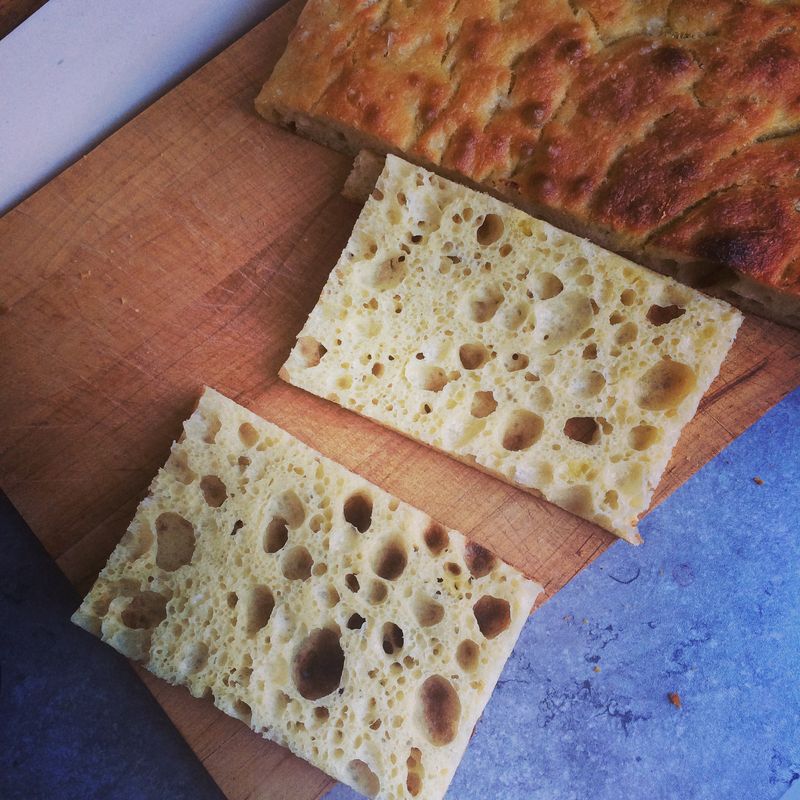
It's pretty spectacular stuff, in the end. The top goes toasty, bubbly and brown and a rich, nutty fragrance fills the air. The focaccia, split open, has the most wonderful bubbly crumb, full of juicy holes to fill with mayonnaise or tomato drippings. I cut off the edges to prepare for our sandwich lunch and then snacked on those edges for a good long time – they are the platonic ideal of the cook's treat. Crisp and crunchy, salty and rich. Cocktail nuts who?
To make Saltie's Scuttlebutt sandwich for Adam and Craig, I filled the sandwiches with the cookbook's pimenton aioli, their pickled beets and herb salad, plus slices of feta and hard-boiled eggs. And it turned out that the whole concoction was just too rich and crazy for me (Adam and Craig liked it, though). But later that evening, I layered sliced tomatoes and a milky piece of mozzarella in a split piece of focaccia and found that I'd made myself a sandwich for the ages. Salty, simple, chewy, oily and juicy. What a home run.
Put this one in your laminating pile, folks. And with that, I'm back to the rest of the World Cup final WHICH I AM NOT HANDLING WITH EQUANIMITY RIGHT NOW AAAAAH.
Saltie's Focaccia
Makes 1 sheet pan of bread
6 1/4 cups flour
2 tablespoons salt
1 teaspoon instant yeast
3 1/2 cups warm water
1/4 cup extra-virgin olive oil, plus more for greasing and drizzling
Coarse sea salt
1. In a large bowl, whisk together the flour, salt, and yeast. Add the warm water to the flour mixture and stir with a wooden spoon until all the flour is incorporated and a sticky dough forms. Pour 1/4 cup olive oil into a 6-quart plastic food container with a tight-fitting lid (or a very large bowl, like the one from a standmixer). Transfer the focaccia dough to the container, scoop a little oil from the sides over the top, and cover tightly. (If you're using a bowl, wrap tightly and thoroughly in plastic wrap, making sure there's plenty of room in the bowl for the dough to rise.) Place in the refrigerator to rise for at least 8 hours or for up to 2 days.
2. When you're ready to bake, oil an 18 x 13-inch baking sheet. Remove the focaccia dough from the refrigerator and pour onto the prepared pan. Using your hands, spread the dough out on the prepared pan as much as possible. Place the dough in a warm place and let it rise until it about doubles in bulk. The rising time will vary considerably depending on the season. (In the summer, it might take just 20 minutes; in winter, it can take an hour or more.) When the dough is ready, it should be room temperature, spread out on the sheet, and fluffy feeling.
3. Heat the oven to 450° F. Pat down the focaccia to an even thickness of about 1 inch on the baking sheet, and then make a bunch of indentations in the dough with your fingertips — like you're playing chords on a piano. Dimple the entire dough and then drizzle the whole thing again with olive oil. Sprinkle the entire surface of the focaccia evenly with sea salt.
5. Bake, rotating once front to back, until the top is uniformly golden brown, 25-30 minutes. Transfer to a wire rack to cool, then slide out of the pan. Use the same day or slice crosswise, cut into squares, wrap tightly in plastic wrap and freeze.


 Site Title
Leave a reply to sara forte Cancel reply