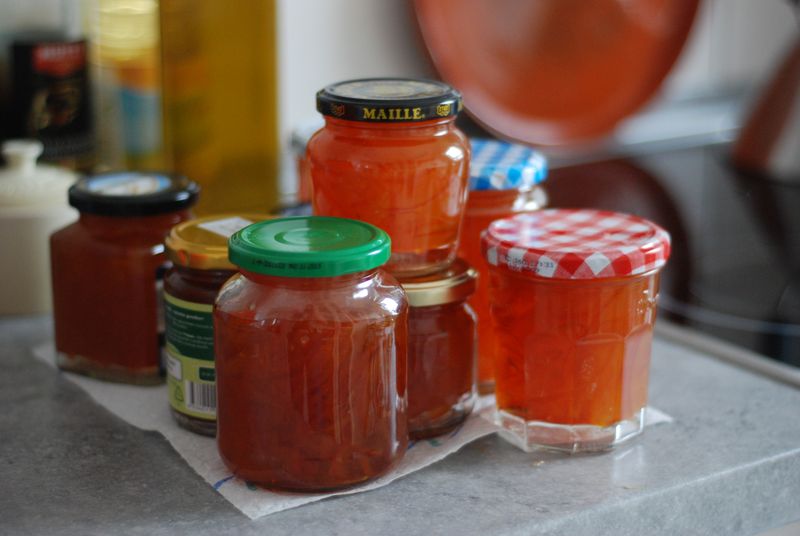
Sour orange marmalade
I have made many a jar of jam in my life – I really like making jam, you guys – but nothing, not strawberries almost candied with lemon grass, not rhubarb and grapefruit preserves, not even the oven-baked, spiced plum butter from my book has ever come close to the experience that making that little cluster of Seville orange marmalade jars up there was. It was transcendental and I know that that might sound like it's bordering on the absurd, but what can I say? Perhaps it takes very little to transport me these days.

Or perhaps, Seville orange marmalade is like the Mount Everest of marmalades – the zenith of jam-making, if you will. And I climbed it at a point in my life when I sort of assumed that nothing of the sort was going to happen any time soon. I mean, you have a baby and then your kitchen priorities shift. You know? I don't want to beat a dead horse, but I just figured that if I could barely make myself a hot dinner the other day, then jam-making, multi-day jam-making, was a far-off glimmer in the future.

But the other day, on one of my market walks, I came across a stand selling Seville oranges (also known as sour or bitter oranges, depending on where you live). This is not a common occurence. In fact, I don't think I'd ever seen them in the flesh before. Over the years, I'd hear now and again in February of someone finding a few knocking about in a bin at some market. But I personally had never had the privilege. In fact, I'd long ago resigned myself to buying orange marmalade, having it be the only store-bought jam in my pantry. Once, on a trip to London a few years ago, I bought a big can of Mamade thin-cut Seville oranges and I made marmalade that I liked very much, but I couldn't help but think, each time I opened a fresh jar, that it was a little pathetic to be eating jam made from canned fruit. There was something so Soviet about it or something.

So there I was, standing in front of this bin of Seville oranges in the biting cold, with my mouth agape and the baby in the stroller next to me. You can imagine that it took me about three seconds flat to buy two kilos.

But then, after I got home with my haul, I got scared. I let the oranges sit on the kitchen table for three whole days while I worked up my courage to deal with them. I knew it was going to take a lot of elbow grease and time – two things I'm really short on these days. When, on the fourth day, I saw a telltale spot of white mold blooming on the peel of one of the oranges, I shook myself out of my stupor. It was time to make orange marmalade, come hell, high water OR a screaming baby. There was no time like the present.
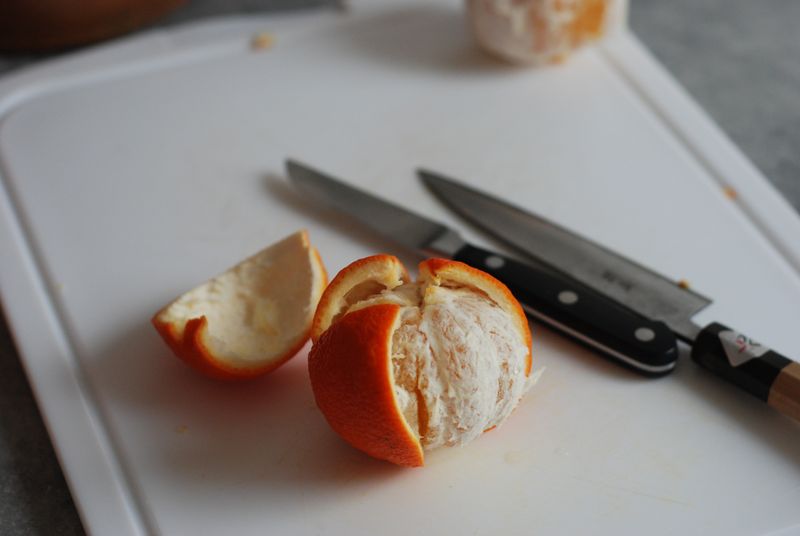
Peeling sour oranges

I consulted The Kitchen Diaries II and a bunch of recipes online (like this one and this one) to figure out just how get started. I liked that Nigel Slater has you score the peel off the fruit without puncturing the orange flesh, so that you start by slicing up the peel before doing anything else, rather than slicing the oranges whole. I put the baby to bed, turned on the radio and got to work.
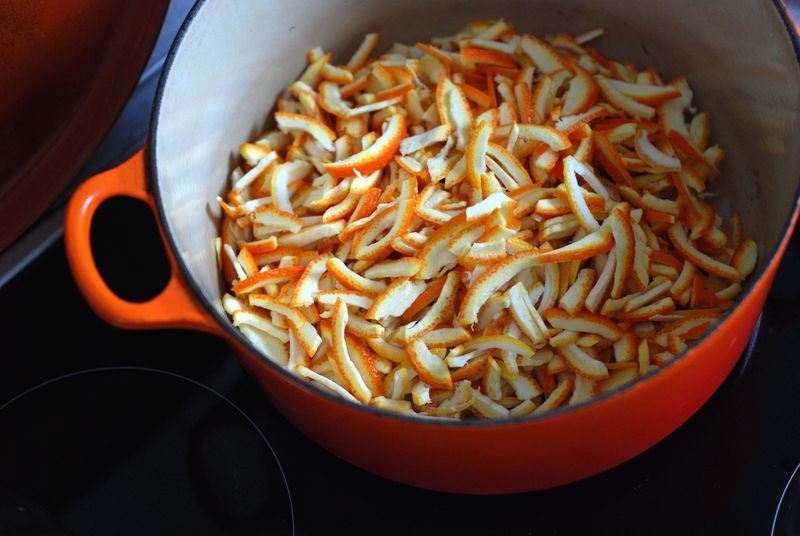
Sliced sour orange peel

Once all the peel was thinly sliced (you can cut it thicker, if that's what you prefer) and resting in my big cast-iron pot, I juiced the oranges into the pot and then extracted every single last sticky seed from the flesh. Seville oranges aren't like regular oranges – they're drier and have more nooks and crannies for the seeds to hide out in. The best way to ferret out those seeds is to push the squeezed orange flesh around on the cutting board – eventually the remaining seeds will squirt out the sides. The de-seeded flesh got chopped up and added to the peel and the seeds went into a mesh metal spice ball that my mother-in-law gave me a few Christmases ago. (I could never really figure out what to use it for, but now that it has redeemed itself as a VIKU, a Very Important Kitchen Utensil, I am considering having it gilded.) I put the mesh seed ball into the pot with the peel and the juice and flesh, filled it up with water and then went straight to bed, my fingers all pruney from having been sunk into sour oranges for two hours.

The next night I brought the pot to a boil and let it cook for a good long while until the peel was translucent and the liquid level in the pot was much reduced. (All of this, the overnight soaking and the long boil, helps get the harsh bitter edge off the oranges, leaving behind a rounded, more agreeable bitterness, if that makes any sense.) Only then did I add the sugar.

Now. Every recipe I consulted has you add twice as much sugar – in weight – as there is fruit. This seems to be somewhat of a rule in orange-marmalade-making. But I could not put that much sugar into the pot. I couldn't! I wanted to, I really did! I like following the rules! But in this case, it hurt my teeth just to look at it (I usually do a ratio of 50%-50% fruit to sugar with regular jams). Since Nigel's original numbers were the following: 1.3 kilos of fruit (he uses Seville oranges and some lemons) and 2.6 kilos of sugar, I decided to do 1.3 kilos of fruit (only oranges) and 2 kilos of sugar. And you know what? My marmalade turned out plenty sweet. In fact, I think I could probably have pushed it even a little lower. Not much, but a little.

You let the sugar dissolve in the hot liquid and then you bring the whole thing to the boil again and let it cook until a little dish of jam stuck in the freezer for a few minutes develops a skin. It took my jam an hour to get to that point. One long, glorious, orange-scented hour. Incidentally, I'm pretty sure I've found my new favorite cooking smell. Bread? Brownies? Roast chicken? Scram, pals.

While the marmalade cooks, you have to skim it a bit, so that your marmalade is sure to be translucent and beautiful when it's done, but I spent most of that hour on the couch watching this, thinking deep thoughts about what Berlin could have been, what Germany could have become, what it squandered and destroyed instead. So the marmalade doesn't really require too much of you.

When it's done, you need your clean jars and lids at the ready, and then you just have to be quick, filling the jars to the brim, wiping off the rims, closing the lids tightly and turning them upside-down. (Letting them cool upside-down overnight gives you a vacuum seal on the jar. And readers: there is absolutely, positively no danger of this jam going bad – the amount of sugar, even the reduced amount that I used, will keep the marmalade safe and delicious for at least a year.)

Seville orange marmalade on toast

The next morning, in the cold, blue, early morning light of wintertime Berlin, I toasted a piece of bread, spread it with salted butter (ever since reading this and then trying it, I have to put salted butter under my orange marmalade – only one example of the many ways Amanda Hesser has given me an education in food over the years) and then put a thin layer of my fresh Seville orange marmalade on top. And. Well. You know.

It was beyond.

It put all those store-bought marmalades and canned-fruit marmalades to shame. This orange marmalade, folks, it tasted alive, for lack of a better word. It was so fresh, I could almost faintly pick out orange blossoms and sunshine in my mouth. I'm not even kidding! The flavor was out of this world. Life-changing. Transcendental.

(Hugo stared at me with such outrage on his little face while I was eating my toast and he was stuck with baby Bircher müsli that I put a corner of my buttered, bitter-oranged toast in his mouth, figuring he'd recoil at the grown-up flavor. HA. He licked his chops and opened his mouth up for more.)

And you know, it was such a thrill. The best part, besides my little arsenal of bitter sunshine in a jar, was really the doing of it all. I'm already excited for next February and that is saying a lot. BERLIN.

Seville Orange Marmalade
Makes about 9 jam jars
Inspired by Nigel Slater's recipe in Kitchen Diaries II

1.3 kilos Seville oranges
2 kilos granulated sugar

1. Wash the oranges. Score the peel of each orange with a sharp knife in quarters and remove without damaging the fruit. Slice the peel thinly or thickly, depending on your taste, and put into a very large cast-iron pot. Squeeze the peeled oranges into the pot, taking care to put any seeds aside. Deseed the remaining flesh. Chop the flesh and add it to the peel. Put the seeds into a mesh tea ball or a muslin bag and put in the pot. Fill the pot with 2.5 liters of cold water. Cover the pot and let sit for 24 hours (I left mine on the stove.)

2. Bring the contents of the pot to a boil. Uncover the pot and let simmer for 45 minutes or until your peel is, as Nigel says, "soft and translucent."

3. Remove the bag or ball of seeds from the pot, squeezing or scraping it for every last bit of pectin. Add the sugar to the fruit mixture and stir well. Raise the heat and bring the marmalade to boil. Let cook for anywhere from 15 to 60 minutes, stirring occasionally, until the marmalade, when spooned onto a little plate that you put in the freezer, forms a thin skin. Ladle the marmalade into clean jars, close them tightly and turn them upside-down to cool overnight. You can wipe any remnants of sticky jam off them in the morning (freshly filled, they'll be too hot to clean up).

Posted in , ,

50 responses to “Seville Orange Marmalade”

  1. Rachel Avatar

    I’m not a big marmalade fan, but it just looks like such fun to make. Maybe I’ll make a whole shipment of the stuff for my grandfather – I know he loves the stuff!

    Like

  2. Leah Avatar

    Oh Luisa. This made me miss things I didn’t even know it was possible to miss.

    Like

  3. Sharmila Avatar

    Gorgeous ‘bitter sunshine in a jar’! Love that phrase and how delicious and jewel-like this marmalade looks.

    Like

  4. Katrin Avatar
    Katrin

    I completely understand – Pflaumenmus and Orange Marmalade are my favorites and I have deep seated fears in making both! Thank you for the courage booster! Now I just need to find some Seville oranges near where I live! You are such an inspiring person – Thank you!

    Like

  5. olga Avatar

    i credit melissa clark with the salted butter, jam on toast. and to think, luisa, of how much toast/butter we’ve wasted through the years. never again!

    Like

  6. Magdalen@FromHeartToTable Avatar

    Oooh, I love jams and jellies! My favorite I’ve made so far is a blackberry jam sweetened with honey and jelled with a univeral pectin. It is barely, barely sweet and bursting with flavor.
    We like using Pomona’s Universal Pectin to make our preserves since it allows us to reduce the sugar levels a bunch without risking jelling problems as well as use the honey from our beehives. The only small downside to making honey jam is that it keeps for less time once opened.

    Like

  7. Tram_cat Avatar
    Tram_cat

    I’m actually doing it now! Not Nigel’s recipe but a mixture of Dan Leppard (BBC) and ‘Pam the Jam’. I’m on the computer while they boil up and I hope to get it done before I go to bed!

    Like

  8. katy Avatar

    I’ve always said I wouldn’t mind dying with the scent of citrus on my hands. Perhaps this is a morbid thought, but there’s just something about the smell of oranges that, just as you said, really is transcendental.
    Glad you had this glorious experience and I’m hoping to get my hand on some Seville Oranges one day to partake in the magic.

    Like

  9. Clara Avatar

    How utterly wonderful! I’d read Nigel’s ode and have been dreaming of the day these show up in my own market. Love knowing you’re stocked up on jars of sunshine to get you through until spring.

    Like

  10. Amanda Avatar

    Ahh, and to think I passed up a bin full at the market three weeks ago. I’m still getting through last year’s mock-up version of marmalade with navel oranges. Not the same. Next year! So glad Februaries (everywhere) are looking up.

    Like

  11. Liana Avatar

    That looks so good I want to cry. I’m so jealous! Six years after learning to make faux marmalade with regular damn oranges I’m still looking for Sevilles.

    Like

  12. Penelope Avatar

    Brilliant! I find it so hard to find marmalade exactly how I like it and I’ve been on the lookout for a good recipe. That tip about the spice ball is great; I have a tea infuser ball that would be perfect.
    The baby/jam-making balance is such a tricky one. My freezer is full of apricots from our tree, waiting for me to have the time and the energy to turn them into jam. The Australian summer is not the best time to make jam, as you can imagine.
    Ruby grapefruit marmalade is worth trying if you can’t find Seville oranges – of course it’s not the same but it does in a pinch, and it’s still better than bought marmalade. Use the usual 50-50 ratio of sugar to fruit, though.

    Like

  13. Katie Avatar

    What a lovely, inspiring post. I bought a couple of seville oranges accidentally once and only then discovered what they were for and went out in search of more to make marmalade. It was my first preserve-making experience and has sort of lingered in my mind as being troublesome and not worth repeating. But I’m convinced now that I need to try again.

    Like

  14. Melissa Avatar
    Melissa

    Amazing! I have been wanting to make orange marmalade, and your post only makes me want to make it even more. Alas, no time…. just the other day I bought a jar of it. Maybe next year?
    But Walter Ruttmann’s Berlin: Symphonie der Grossstadt! A great film, and I’m so happy to find it online – thank you!

    Like

  15. Janel Gradowski Avatar

    I have read this blog for years and now I am reading your book. As always, I am captivated with your writing. Enjoy that sunny marmalade and let it chase away the chill of winter.

    Like

  16. Hannah Avatar

    That smell! I’ve never made marmalade (though now I’d love to try!)but I candy orange peel every year, and I wish my house smelled like that always. Enjoy your special treat – I hope the joy from making it lingers as long as the marmalade itself.

    Like

  17. Victoria Avatar

    I NEVER buy salted butter, but based on your recommendation I will get some, in spite of the fact that the most decadent jam-related thing I ever ate was a fresh croissant spread with cold UNsalted butter and marmalade.
    I can still taste it.
    Last year I spied some Seville oranges at Fairway and made Nigella’s Seville orange curd from How to Eat. It was really wonderful, totally worth making.

    Like

  18. Sissy Avatar
    Sissy

    I would love to have seen the look on Hugo’s little baby face when he tasted your toast and marmalade!

    Like

  19. Agnes Avatar

    Must try that some day. At the moment, homemade jam of yellow mirabelles is my favourite – slightly sour and sweet, tasting of both apricots and plums – but then I never made jam of Seville Oranges. Maybe that will be my next favourite, or perhaps mirabelle jam will continue to hold the throne, due to my northern hemisphere upbringing. I’ll have to try and see 🙂

    Like

  20. Phoebe Avatar
    Phoebe

    This looks so wonderful, I’ll be keeping an eye out for Seville oranges now. Can I ask about your jars? I just moved to the UK (from the US) and I noticed at a church jam sale that little old ladies were selling homemade jam in old store-bought jam jars. I’d had it drilled into me that one must use ball jars with brand new lids or else… doom! Trouble is, I haven’t seen ball jars here, only Weck jars and they are hella expensive. I’d been regretting giving away my monstrous stash of ball jars right before the move. So, what’s the deal, is it really safe to can in old jars? Can you use them over and over again? How do you know you’ve got a proper seal? Thanks!!!

    Like

  21. Sylee Avatar

    Soviet! Still laughing… And in love with the image of little Hugo sneaking a corner of jammy goodness.

    Like

  22. Gemma Avatar

    I’m not a fan of marmalade (although I do now make jam every Summer when the Scottish strawberries appear) but my Grandad used to make it every year and now my Mum makes it each January, in part because she likes it but also, and more significantly, because it reminds her of him.

    Like

  23. Carmen Avatar
    Carmen

    Did Nigel’s recipe but with 2 kg light brown sugar and .6 kg white sugar. Wow!!!!!

    Like

  24. Luisa Avatar

    Phoebe – for preserving vegetables or making pickles, you need to use fresh lids and seals every time. You’re processing those things in a water bath. However, for jams which have high sugar contents, you really don’t need to worry about using Ball or Weck jars. Those are mostly just for preserving fresh produce. And yes I use my jam jars/lids over and over again. Eventually – as in, after several years – you might start to notice that the linings of the jar lids aren’t so spic and span anymore. Then I’d get rid of them. But otherwise there’s no reason to buy new jars every time you make jam. In my experience, jam-making in America is surrounded by this shroud of unnecessary dread! As long as you’re not making low-sugar jam, there’s very little that can go wrong (read: nothing).

    Like

  25. Kim Avatar
    Kim

    This is my favorite post of yours EVER. You’re writing is so alive!!!!!!

    Like

  26. rozinchina Avatar
    rozinchina

    yum! i love jams & this sounds lovely.
    i fell like i have to say this, i live in romanaia (an ex-soviet block country) and i can tell you – no mother or grandmother would ever buy jam, everyone would cook it from lovely all natural fruit. i think nowadays, with all the shops and the diversity of available stuff, people are starting to forget to cook jam, as it seems to complicated so buying it seems rather western-europe to me

    Like

  27. rozinchina Avatar
    rozinchina

    i re-read what you said and I think i missunderstood what you meant. i agree with you now – canned fruit – very soviet indeed!

    Like

  28. Lindy Avatar
    Lindy

    Luisa Am loving your book. Thank you for giving me permission to use canned (boxed at whole foods these days)beans and I dressed them with what I could eat (allergies) a tart sweet dressing and they were delicious. Am going to try the Sicilian pizza. never used flour in my life! Am inspired!

    Like

  29. Doris Avatar

    I love making jams and, just a couple of years ago, marmalade as well. I make mostly citrus-based ones since we live in Florida. My mother-in-law has a few calamondon (sour orange) trees and when there’s an over abundance for me to have…it’s marmalade time!!!

    Like

  30. Sheena Avatar
    Sheena

    I absolutely hated marmalade until I started making my own (I also love jam making almost more than anything else!), and I started with Rachel Saunders’ recipe for Seville orange marmalade. I decided to put a vanilla bean in mine, which made it taste like orange creamsicle. Soooo good!

    Like

  31. Kat Avatar

    Oof – I’m with you on the sugar to fruit ratio! For a kilo and a half of fruit, I use two of sugar (and sometimes skip a bit even of that. Mind you, I do like my marmalade very tart, and prefer it to spread itself…)

    Like

  32. Figs'n'rhubarb Avatar
    Figs’n’rhubarb

    I still had a tiny jar of seville orange marmelade I was given month ago siting in my fridge – thanks to you it is now empty and I had a wonderful breakfast!

    Like

  33. Stephanie Avatar

    I’m so glad you’ve discovered the joys of making marmalade in the middle of winter! AND that you were able to find Seville oranges. I couldn’t find any last year and was so disappointed . . .
    This Monday, I finally found Seville Oranges in my severely-citrus-deprived city! I’m going to make up a batch of whisky marmalade on Friday and I can hardly wait. (:

    Like

  34. Steve John Avatar

    This post was really clever– it makes me think it would be brilliant if you had a cooking show.

    Like

  35. carissa Avatar
    carissa

    I think I have only eaten marmalade once in my life and it was nothing to write home about. I’m feeling seriously cheated now having read this. I need to get my hands on some bitter oranges. I’ll try somehow to get past the obscene amount of sugar and live a little. 🙂
    I love using “Soviet” as a descriptor! Hilarious. Have you ever seen the (British) show The IT Crowd? There’s an episode where one of the characters takes up smoking again but the smoke break area at her workplace is “too Soviet”, which becomes a running gag throughout the episode–it’s cold, gray, desolate, she starts wearing a babushka scarf to keep warm, etc. One of my faves.

    Like

  36. Louise Avatar

    That marmalade looks beautiful! I spent a lot of time making rubbish marmalade before it got as good as that. My saviour (although it takes much more effort) was June Taylor’s recipes, or at least the few of them that have been published in newspapers.
    I made Seville orange marmalade this year too, but also reduced the sugar – quite dramatically. For 1.5kg fruit, I used only 750g sugar (to match the 750g of pulp and juice I actually got). It has set nicely – a soft set, but set nonetheless
    http://usingmainlyspoons.com/2013/01/20/seville-orange-marmalade/

    Like

  37. Joris Avatar

    Hi Wednesday Chef! Just a tip I learnt, if you blanch the oranges before you peel them they will give you a bit smoother tasting jam (less bitter tang). But some people like this so its just a suggestion! 🙂 thanks for the post.

    Like

  38. Sonja Avatar
    Sonja

    This recipe looks great and I’m all set on trying it. Just a question out of curiosity – why is it necessary to boil the orange seeds together with the fruit? Does it add anything to the flavour?

    Like

  39. Luisa Avatar

    Sonja, the orange seeds contain the pectin that makes the jam set properly.

    Like

  40. Luisa Avatar

    Joris – I think that’s why, in this recipe, you soak the peel for a day and then boil it for almost an hour before adding the sugar.

    Like

  41. jemitchell99@hotmail.com Avatar
    jemitchell99@hotmail.com

    Luisa, your story was so entertaining to read! I’m on a mission to find Seville oranges now, not sure if they can be found here in California. Thanks for the inspiration!

    Like

  42. Ambica Avatar
    Ambica

    I loved this post…This is the first year I made Marmalade too using the 1:1:1 ratio of fruit, water and sugar. Here is a link to the NY times article.
    http://topics.nytimes.com/top/reference/timestopics/subjects/m/marmalade/index.html
    And Elizabeth Field has written a lovely book on marmalade too.

    Like

  43. Gerlinde de Broekert Avatar
    Gerlinde de Broekert

    Hi Luisa,
    I have never heard of Seville oranges until I read you post, but here in California I’ve been using blood oranges . Are they similar?
    I slice 1 kg of blood oranges and 2 Meyer lemons into very thin slices , collecting the juice and discarding the end pieces of the fruit. I cover them with 500ml of water and soak them for 24 hours. then I cook them for an hour or so with the lid on.
    I then add 1kg of organic sugar and cook it until it thickens.

    Like

  44. Anita Avatar
    Anita

    Many, many lives ago, I made bitter orange marmalade from the fruit of some glorious trees growing in my exotic Florida backyard. The recipe I used was almost exactly the same as this one, including the labor intensity. The one difference was that I used a potato peeler to remove the outer orange zest from the white pith, before proceeding with the soaking, changing of water, simmering, soaking, until the peel became jewel-like and translucent after all that alchemy. It was just as delicious as it was beautiful! And very gratifying, because I had been just as terrified as you were, before I screwed up the courage to tackle that daunting project. I moved from that lovely tropical garden years ago, and miss the bounty of those fruit trees. Loved reading your recipe and .commentary.

    Like

  45. Jessica Avatar
    Jessica

    I have a couple of questions:
    1) How big is your mesh ball? I thought to use my stainless steel tea ball, but I have MUCH too many seeds for that. Should I put all the seeds in the orange soak?
    2) My cast-iron pot is way too small to fit all the oranges + water, so I put the whole mess in a big stainless steel pot (in which I plan to cook the thing, too). What’s the reason for stipulating a cast-iron pot in the recipe, and do I risk ruining the marmalade if I cook it in a stainless steel pot?
    Thanks! So excited about this recipe.

    Like

  46. Luisa Avatar

    My mesh ball is quite large, about 4-5x larger than a tea ball (it’s meant for spices). You should use all the seeds – you can bind them up in a piece of muslin cloth. Cast-iron (coated) is great for marmalade, because the material is so thick that you don’t risk scorching the marmalade during the long cooking process. If your pot is good and thick and you take care to always regulate the heat and stir, you should be fine with stainless. Have fun.

    Like

  47. Luisa Avatar

    They’re very different – bitter oranges are not for regular consumption, they’re so bitter and sour. Blood oranges are delicious eaten just like that! Your jam sounds lovely, though.

    Like

  48. Cliff O'Hearne Avatar
    Cliff O’Hearne

    In the 1960s I had a new house in Florida built on a site that had been part of an orange grove. As Florida orange trees are grafted on sour root stock, I had two sour orange trees growing in my door yard. I cannot remember whether or not I made marmalade–Keillers was better then. But I did use the juice for whiskey sours. With 100 proof Old Grandad, the drink was perfecto.

    Like

  49. Mary Avatar
    Mary

    Jan 2014
    We picked the sour oranges( we call them ugly oranges) followed directions until the end.. could not wait to taste.. tried the toast, butter and marmalade immediately.. wonderful.. we love it.

    Like

  50. Robert Avatar
    Robert

    double the weight of fruit in sugar? That’s madness! The fundamental recipe is 1:1, but I prefer it a little less sweet and use 75% of the weight of fruit – my usual batch is 2lbs sevilles, 2 lemons, 1.5 lbs sugar. It would be horribly, inedibly sweet with more than 1:1!
    – this based on many years of making marmalade with Seville oranges fresh off the tree on the south coast of Spain

    Like

Leave a reply to Clara Cancel reply