Baguettes_1

I've said it before, but I'll say it again: there's really nothing like homemade bread. Nothing else comes close to the smell and warmth it imparts to the house, nor the sense of completion I get when I pull crusty loaves from my oven and let them cool on the table. I eat bread almost every day – it's a staple of my existence – so having it freshly made and available just makes sense. Although I'm surrounded by places where I can buy good bread (imagine – even the d'Agostino's around the corner sells bread from Tribeca Oven), I will always prefer to make my own. I can fiddle with new recipes, sink my fingers into cool, elastic dough, and commune with the hippy inside me (present since I tie-dyed my underpants and wrote a research paper on Woodstock in the 10th grade). Now that hippy has moved on from experimentation with fabric dyes to just wanting to bake bread, make her own yogurt and cheese, and grow her hair out. Not very counterculture, I know.

The slender baguettes above came from my latest batch of baking in which I followed a recipe that Molly O'Neill published when she still wrote for the New York Times Magazine regularly (every bio I found of her online says that she still is the food columnist for the magazine, but I think those are in need of a bit of an update). The piece was on artisan bakers at a time when artisan baking was just becoming mainstream. Maggie Glezer's fantastic book was published later that same year. Loaves of crusty bread with irregular pockets of air studding the creamy interior flooded bakeries, and people were becoming acquainted with words like poolish, autolyse, and biga.

The Standard Baking Company, now found under Portland's famous Fore Street restaurant, was known in foodie circles to have great, European-style bread. Using one basic poolish (a mixture of flour, water and yeast that is allowed to rise, then added to the dough to give the baked bread a better, fuller flavor), the bakers at Standard developed three recipes to incorporate it. I tried the baguette recipe first, but I plan to make the other two (a rustica and raisin-pecan) as soon as I find a bit more time. I made the poolish one afternoon by stirring together cake yeast (difficult to find, at least in lower Manhattan), flour and water and letting it sit for several hours. This fragrant slop was then to be measured out and added to a fresh bowl with flour, more cake yeast and water.

Unfortunately, it was around this time that I walked into my bathroom to wash my hands and saw a shiny cockroach amble languidly across the floor, sending me shrieking and wailing into the other room while Ben killed it and flushed it down the toilet. I, of course, had to also then vacate the premises and could return only at the point in which I didn't see a largish insect every time I closed my eyes or blinked. I'm such a girl, I know. A cowardly, wimpish girl. But there's something about roaches that just induces utter despair. You know they're there, lurking in the walls, too close for comfort. But you get through most days staying out of their way (and vice versa). When that delicate balance is thrown out of wack by the appearance of a roach in your personal space, it brings to light just how foolish and delusional you are for thinking you could live life avoiding them. Anyway, luckily for me, the poolish could be refrigerated.

The next day, with teeth clenched and eyes firmly ignoring all peripheral movement, I kneaded together some poolish, flour, water, salt and cake yeast into a shaggy dough, then let that sit for 15 minutes. I then tipped the dough out on the counter and kneaded it until it was smooth, about 10 minutes. I covered the dough and let it rise for an hour.
First_rise_3
I tipped this gently back out on the counter and folded it in half. It then went back into the bowl to rise again.
Folded
An hour after that, the dough held the imprint of my hand when I pressed it gently, so I turned it out and divided it into three pieces. I shaped the pieces into logs and put them on a floured sheet.
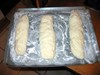
Folded_and_shaped
O'Neill instructs you to fold the long sides of the loaves into the middle to create the baguette shape. I found that confusing, but managed to shape loaves that looked just fine.
Shaped_2
These loaves rose a third time. After an hour or two, I heated the oven, slashed the baguettes (badly) and slid them in with a makeshift steam system of icecubes in a pan at the bottom of the oven (because I was too disorganized to get a spray bottle).
Risen_and_slashed
The baguettes baked until they were crusty
and golden (O'Neill says this should take 16 minutes; my nutty oven took longer). I let the loaves cool on a rack, then broke one open to eat with dinner.
Interior

We ate half of that baguette for dinner. The crust was crisp and the crumb was warm and delicious (if a bit salty). I wonder what the difference to the crust would have been if I'd used a spray bottle or a pizza stone to insulate the oven. I wrapped the rest of that loaf in aluminum foil to reheat, sprinkled with water, for breakfast. In case you didn't know and were throwing out "stale" baguettes, the sprinkling of water and short time in the oven revives any limp baguette to its formerly crusty state. I froze the other two baguettes.

I'm not sure this is the baguette recipe: I'm still holding out for one that will deliver something closer to the Retrodor I loved to eat in Paris (though I realize that professional ovens, and water and flour quality in France has much to do with the flavor and texture). But the satisfaction that comes from biting into your own bread really makes up for almost everything.

Posted in

13 responses to “Standard Baking Company’s Baguettes”

  1. Maya Avatar
    Maya

    Those baguettes are stunning! I am so jealous. All you need now is some good Irish butter to slather on that bread… In fact, email me and I will send you some!

    Like

  2. lindy Avatar

    These looks really good, I’ll bet they smell great, too. If you are in the mood for comparative baking of multiple baguettes…I love the Acme Rustic Baguettes in the Glezer book.
    In fact, I’m crazy about that book in generally, and I’m very tempted by her new book on Jewish breads. As if I didn’t have enough cookbooks….

    Like

  3. Molly Avatar

    Beautiful baguettes, ma cherie! Funny, this post reminds me that I have been horribly lax in my bread-baking. This time last year, I was baking like there was no tomorrow. You’re right – it is so satisfying. Must! Bake! Again!
    Oh, and thanks for the tip on the Glezer book. Brandon has been experimenting with bread and has been using Peter Reinhart’s The Bread Baker’s Apprentice, but I wonder if Glezer’s book might be a good addition to his library. Hmmm…

    Like

  4. Melissa Avatar

    Gorgeous baguettes, Luisa, I’m very impressed! They’ve always been something I’ve wanted to try making, but I’ve never found the nerve. Maybe it’s time to give in and buy Glezer’s book.
    I can totally relate to your cockroach trauma. I used to live in New Orleans where they were as big as guinea pigs, and god forbid I spotted one in the house anywhere, I wouldn’t be able to sleep until it had been caught and disposed of. I’m shivering at the memory!

    Like

  5. Alizah Avatar
    Alizah

    Ben the hero!!! Is the moral of the story that baguettes make better roach-beaters than boules?

    Like

  6. Pru Avatar
    Pru

    Yum! I used to make all (well MOST) of our family bread in the late sixties and seventies when finding good commercial bread was a real problem. Not so necessary today, but I’ve recently starting up again just for the fun of it. If you are in a real hurry the Cuisinart baguettes proposed by Pierre Franey in Cuisine Rapide are foolproof and wonderful, and can be improvised upon (part whole wheat, add a little butter and/or buttermilk for longer keeping, etc etc.). I can post or send the recipe if you like.

    Like

  7. From Our Kitchen Avatar

    These baguettes look incredible, like something you’d find in a bakery. The crust looks good and crispy, not too thin or lacking in crunch. I think I could eat bread (especially bread like this) for every meal every single day.

    Like

  8. mumu Avatar

    The baguettes look really good! Yum yum! I agree with you. Homemade bread are the best. It makes me happy. I’ve started making bread lately — cinnamon rolls and soft pretzels. Baguettes are on my list too!

    Like

  9. Luisa Avatar

    Maya – we could set up quite a mail-order racket between the two of us…bread in one direction, butter in the other. Thank you!
    Lindy – I’ve only been able to use Glezer’s book for weeks at time; I keep checking it out of the library instead of just buying myself a copy. Which is just silly. I have a challah recipe from her new book that I’ll be trying sometime soon (NY Times).
    Molly – thank you! I think the Glezer book is truly lovely – it’s got beautiful photographs, good recipes and interesting stories. A great package – I’m sure Brandon will love it. Though Reinhart is also good at what he does! Can’t wait to read what baking you’re up to.
    Melissa – I’m sure you’d master the baguettes in a flash. And you’ll the love the book (I feel like I’m plugging something here… 😉 As for cockroachs as big as guinea pigs, I’m going to go gouge my eyes out after finishing this comment.
    Alizah – Ben was so quick about rescuing me from imminent death by utter disgust that he should be awarded his own cape and superhero goggles. Armed with a baguette! Or, you know, a good and dirty gym shoe.
    Pru – that recipe sounds intriguing, especially because it sounds like it has a quicker prep time. I’d love it if you could either email to me or post it here in the comments…Thank you so much!
    From Our Kitchen – thank you! Your baking’s not too shabby either, I have to say. Those were gorgeous challahs you made the other day.
    Mumu – Thanks! And soft pretzels? I will have to hunt those down.

    Like

  10. Pru Avatar
    Pru

    Here it is. I often make just half the recipe.
    Quick French Bread
    from “Cuisine Rapide” by Pierre Franey & Bryan Miller – 1989
    2 envelopes fast-rising active dry yeast
    2-1/4 cups warm (90 degrees) water
    6 cups unbleached all-purpose flour
    1 tablespoon salt
    2 ice cubes
    1. Preheat oven to 400° (when you are ready to bake, not right now)
    2. Place the chopping blade in the food processor bowl. Add the yeast and 1/4 cup warm water. Mix by turning the chopping blade by hand. (Turn the stem without touching the sharp blade. Just to be extra cautious, unplug the machine.) Add all the flour. Turn on the machine and blend for 5 seconds more. While the blade rotates, add the remaining 2 cups water. Blend until the batter begins to form a large ball, 20 to 25 seconds.
    3. Flour a board and knead the dough on it, forming it into a ball. Flour a large mixing bowl and place the ball of dough in it. Sprinkle the top with flour. Cover it with a dish towel. Let the dough rise until it doubles in size. The time required varies with environmental conditions, but at a room temperature of about 75 degrees it will take at least an hour. (I often put it in the fridge overnight at this point.)
    4. Remove the dough from the bowl, punch it down, and shape it into loaves. This quantity is sufficient for 5 baguettes about 18 inches long, each stretched along the length of a tubular French loaf pan. Or make 2 thick French loaves about 14 inches long. (Don’t stress over the shaping of the loaves. The size of my cookie sheet determined the length of my baguettes.) Of course if you have a baking/pizza stone, you can bake the loaves directly on it, forming them on a cornmeal-dusted peel.) NOW you can preheat the oven to 400.
    5. With a razor blade, diagonally score the surface of the loaves several times, making each incision about 1/2-inch deep. Because of the fast-rising yeast, you don’t have to wait for the loaves to rise much, if at all.
    6. Place the loaves in the oven and throw ice cubes on the oven floor. The ice adds steam to help produce a thin crust. Bake for 30 minutes. Lower the oven temp. to 375° and bake for 10 minutes. Transfer the bread to a rack and let cool.

    Like

  11. Shuna Avatar

    Oh how I miss Molly O’Neill! I know this will sound like whining but no one writing there is as good as she was. Although I like when Amanda Hesser shows up, she’s always a little too neat.
    I only remember making baguettes as being really hard on my hands. It’s because we were making Ficelle.

    Like

  12. Luisa Avatar

    Pru – Fantastic. Many many thanks!
    Shuna – O’Neill really does have a great way about her writing. This recipe was easy – there was only one kneading stage, and although it was 10 minutes long, the dough was ever-so-soft. Was the dough for ficelle the same as for baguettes?

    Like

  13. Lisa Gottesman Avatar
    Lisa Gottesman

    Standard Baking Company has the most incredible oatmeal raisin cookies and financiers i have ever eaten. Does anyone know where to find these recipes?
    lisa

    Like

Leave a reply to Melissa Cancel reply