• Brussels

    Hmph. I don't know who to blame this failure on. And I'm getting sick of the Thanksgiving recap. After this, there's only one more recipe and it's worthwhile, I promise. But in the meantime, I'm going to grump all over this post.

    We are a Brussels sprout-loving family, I would say. Maybe not 20 years ago, when my father would steam frozen ones and make me eat four: two big ones and two small ones. But I've grown in more ways than up over the years, and now I can enjoy an entire serving or two of sprouts on a regular basis without screwing up my face and holding my nose shut as I swallow. Most Thanksgivings, my father makes a festive Brussels sprout dish with onions and apples and walnuts. This year, though, I had to mess with a good thing by introducing a recipe by Regina Schrambling from a two-year old LA Times piece.

    It calls for pistachio oil, which we searched for high and low at Whole Foods, at Russo's, and at two different Indian grocery stores (which boasted a great selection of all kinds of oils, except, of course, for pistachio), to no avail. We settled for using olive oil instead, but I can't help but wonder if this substitution was at fault for the dish's lackluster flavor. We did use a gorgeous pile of rose- and green-tinged pistachios, and the freshest sprouts I had ever seen. But we made the dish a few hours before our guests arrived, and I fear the time spent in the bowl might have softened the nuts and brought out a fearsomely cabbage-y taste from the sprouts.

    In the end, I also have to ask myself if it just wasn't the most inspired recipe from Regina Schrambling. I love her stories and her biting wit, but her recipes have been hit or miss. Go to Orangette or Stephen Cooks for much better Brussels sprout recipes, and hope that my mood is better tomorrow.

  • Pie_1
    I suppose I should have known that when attempting to bake three pies in one day – the most important food day of the year, I might add – one cannot expect all three of them to shine. If you have already managed a glorious squash pie and a stellar apple pie, well, then it must not be good karma to have your pecan pie dazzle, too. Which is too bad, because it certainly looked the most promising.

    The recipe came from an article on pecans in the LA Times in 2001. The delicate filling called for honey and rum instead of corn syrup. I figured it might be a nice change from the traditionally sweet and sticky version. Well, I figured wrong. The pie looked absolutely gorgeous – a toasty brown filling that puffed up nicely in the oven and then squidged down into the all-butter crust – but tasted totally odd. Like…soap! I can't figure out why: rum, butter, honey and vanilla, not to mention a mess of pecans straight from Texas, these are all good-tasting things. How in the name of turkeys everywhere did this combination go so wrong?

    First, I beat together butter and honey into a gorgeously unctuous cream that practically begged to be smeared on toast or waffles.
    Honeybutter
    To that I added rum, vanilla, eggs, salt and nutmeg. When the pie crust was rolled out, fitted into a tart pan and chilled, I parbaked it for five minutes, which really only seemed to make it greasy.
    Parbaked
    In went the pecans in an even layer,
    Pecans
    and then the filling was poured over.
    Filling_3
    The pie went into the oven and baked for about 15 minutes longer than specified, until the nuts were browned and the filling had puffed up.
    Puffy
    Ms. Shulman says that people like her pie because it's less sweet, but that's just no justification for this misbegotten pie that tastes of suds. Pecan pie was meant to be tooth-achingly sweet and chewy, the better to eat with a pile of whipped cream. Next time, I'll be looking elsewhere for a real pecan pie. Any suggestions?

  • Jam
    With 16 people needing to be fed on Thanksgiving, we decided to make two cranberry sauces. Can you ever have too many? Our traditional sauce is lovely – full of citrus notes and toasted nuts – and comes from my step-mother's grandmother. If sauces had personalities, the traditional sauce would be a dainty Southern lady and the cranberry onion jam be a flannel-shirted lumberjack. These are ridiculous metaphors, yes! But I dare you to try them both and see if you don't agree.

    The recipe comes from a clipping that might be among my oldest ones. It dates back to an article Amanda Hesser wrote in 2000. The silky, savory jam has an acidic kick from cider vinegar and the vermilion bloom of tart cranberries. The caramelized onions add another layer of sweetness and tang. It's a delightful little condiment that makes even tired, 4-day-old turkey taste good while eaten on that most gastronomic of locales: a Greyhound bus.

    Make sure you ignore the cooking times that Jasper White specifies at each stage – his version will leave you with a mess of parcooked onions and mostly unpopped cranberries.

  • Slice_7

    Those tender apples! That flaky crust! This pie was a labor of love. At first, it made me want to pluck my eyes out and wail like a banshee. Then I wanted to dump the entire thing into the trash. But in the end it won my heart. Some people at our dinner party even said it was the best apple pie they'd ever had. I warn you: it is a pain in the neck. It might take you the better part of a day or two. You might find yourself whimpering at times. (This is beginning to sound like childbirth. I realize I may be overdramatizing for effect. Clearly this is necessary to illustrate my agony.) But stick with it: the rewards are outstanding.

    The recipe comes from an L.A. Times Thanksgiving story that's two years old. Upon rereading the article after baking the pie, I realized that I could have benefited from some of the writing's calm tone. You are supposed to let the quince roast for 3 hours (we took the pan out after two, fearing total quince collapse thereafter.). The pie dough is supposed to be studded with clumps of unprocessed butter, rendering the rolling of it an exercise in nerves. The filling is supposed to be piled as obscenely high as a pie at the Carnegie Deli – that's what makes the pie so satisfying. What a relief!

    As for the crimping job I did – well, let's just once again thank my parents for prevailing with their common sense and preventing me from chucking the entire thing. In hindsight, I have to agree – the pie looks nice! I think fear-of-overhandling-pie-crust-itis might have colored my judgement.

    In the end, this gloriously burnished pie was a delight. It baked for exactly the amount of time specified. It came out glossy from the egg wash, sparkly with cinnamon sugar, and when the knife sank through the crust, it crackled and flaked just as it should. And the flavor – tart apples that kept their silky shape, gorgeously perfumed roast quince, a perfect blend of spices – was stunning. At Thanksgiving we served it with softly whipped cream. But it was equally wonderful cold and plain the next day, and the day thereafter. Then it was gone. I can't believe I'm trying to figure out when I can next attempt it.

    Apple-Quince Pie
    Makes one 9-inch double-crusted pie

    6 medium quinces
    2 cups freshly squeezed orange juice
    1 cup dry white wine
    2/3 cup plus 3 tablespoons sugar, divided
    1 vanilla bean
    1 double-recipe pie crust dough
    6 medium apples, peeled, cored and cut into 1/4-inch slices
    3/4 teaspoon cinnamon, divided
    1/4 teaspoon ground nutmeg
    Pinch of ground cloves
    1 teaspoon sifted cornstarch
    1/2 cup unsweetened applesauce
    1 teaspoon vanilla extract
    4 tablespoons melted butter
    1 egg

    1. Heat the oven to 375 degrees. Peel, quarter and core the quinces, and cut them into one-fourth-inch slices. Place them in a 9 1/2-by-11-inch baking dish, along with the orange juice, white wine and one-third cup sugar. Slice the vanilla bean and scrape the insides into the dish. Stir to combine, cover with foil and roast for 1 hour.

    2. Opening the oven briefly, lift the foil and stir the quinces. Roast another hour. Repeat twice, for a total of 3 hours of roasting time. Let the pan cool, then chill for 1 hour.

    3. Divide the dough in half. Keep half in the refrigerator and roll out the other half into a 13-inch circle one-fourth-inch thick. Fit it into a buttered, 9-inch pie plate. Fold the edges in and down to form a three-fourths-inch overhang all the way around the pie. Chill it in the refrigerator.

    4. In a large bowl, toss together the apples, one-third cup sugar, one-half teaspoon cinnamon, the nutmeg, cloves and cornstarch. Add the applesauce, vanilla extract, melted butter and roasted quinces and gently toss again. Fill the pie, mounding the filling gently. Chill.

    5. Roll out the remaining dough into a 13-inch circle, one-fourth-inch thick. Take the pie from the refrigerator and drape the dough over the top of the filling. Fold the edge forward, dropping the dough into the crevice between the mound of filling and the side of the plate. Lay the overhang of dough onto the bottom lip. Use scissors to trim, leaving one-half-inch beyond the edge of the plate. Crimp in a rustic fashion. Chill for one hour.

    6. Heat the oven to 350 degrees. In a small bowl, whisk the egg. In another small bowl, combine the remaining 3 tablespoons of sugar and one-fourth teaspoon cinnamon. Brush the surface of the pie with the egg, then sprinkle it with the cinnamon sugar. Use the tip of a sharp knife to imprint a star design onto the top of the pie, cutting only halfway through the dough, or decorate with leaves cut out from extra dough. Pierce a hole into the center of the pie to allow steam to escape.

    7. Bake until shiny, dark golden-brown and bubbling at the edges, 1 hour and 50 minutes to 2 hours.

  • Father
    I thought I'd start today's post with an Action!shot because I should pay tribute to those hardworking hands of my dear father, who so patiently and selflessly peeled pounds and pounds (or ounces and ounces) of pearl onions the day of Thanksgiving. Do you see the filmy little onion membrane? The gloopy texture of the half-cooked orb? The irritating fussiness of the act of peeling an onion? Father! Tribute has been paid. Thank you and thank you again. Sadly, all that effort was, if not for naught, then for nothing special.

    Two years ago, the New York Times ran a Thanksgiving article with recipes culled from 12 different chefs, including Barbara Lynch of Boston's No. 9 Park. Her contribution was a dish of creamed red and white pearl onions. The photo accompanying the recipe was gorgeous – tiny onions napped in a creamy sauce and topped with a crisply browned cap of breadcrumbs. It sounded irresistible and just the thing for the Thanksgiving table.

    But there were a few problems. First of all, the recipe calls for blanching the onions for 5 minutes, and then peeling them (Father! Thank you again! The tribute-paying continues!). It wasn't until the dish was on the table that we realized the recipe never really called for another cooking stage in which the onions would be fully cooked. A pass under the broiler doesn't end up doing much to par-cooked onions. So they were a bit crunchy, instead of being slippery-tender.

    Also, the amount of cream called for was terrifying. We cut the amount by half, and there was still an overwhelming amount of sticky cream to deal with. Instead of lightly coating each onion, it pooled around the lot of them in an unappetizing sludge. The flavor of the whole dish was not bad – if you like bacons and cream and partially cooked onions – nothing to turn your nose up at. But it was too heavy, too oily, too raw for us.

    The final problem, which was my fault entirely, was forgetting the dish under the broiler for one minute too long. The breadcrumbs were singed to a blackened crisp. I panicked. And then a delightfully calm and collected dinner guest swept in, assured me in no uncertain terms that blackened breadcrumbs would bring flavor and texture to the dish, and helped me pick off the most offending bits. Now that kind of guest should be present at all dinner parties: to encourage the exhausted cook, help in times of crisis, and still tuck in heartily to the meal. Thank you, Ourida!

    Creamed Red and White Pearl Onions with Bacon
    Serves 6-8

    2 10-ounce bags red pearl onions
    1 10-ounce bag white pearl onions
    2 1/2 ounces thick cut bacon, diced
    2 tablespoons butter
    2 shallots, minced
    1 garlic clove, minced
    1 1/2 pints heavy cream
    1/2 cup fresh breadcrumbs
    2 tablespoons chopped parsley

    1. If red and white onions are about the same size, bring a large pot of water to boil over high heat. Add onions and blanch until skins loosen slightly, about 5 minutes. Drain. (If white onions are considerably larger, blanch onions separately, increasing time on white onions by a couple of minutes.) Peel onions and set aside. (Onions can be peeled and blanched ahead of time. Place in 2-quart zipper-lock  bag and refrigerate until ready to use.)

    2. Saute bacon in a Dutch oven over medium-heat until crisp, about 5 minutes. Transfer to a paper-towel-lined plate and set aside. Pour off bacon fat. Melt butter in Dutch oven over low heat until foaming, add shallots and garlic and cook until translucent but not browned, stirring frequently, about 3 minutes. Add heavy cream and simmer until cream is thick and golden, and has reduced by half, 10 to 15 minutes. Stir onions into cream to heat through.

    3. Heat broiler. Turn onions and cream into a shallow 11/2-quart casserole dish. Top with bacon, bread crumbs and parsley. Place under broiler and cook until crumbs are browned and dish is bubbling, about 10 minutes.

  • Carrots_1
    This year, Thanksgiving was all about the blog. With the exception of the turkey and the stuffing and the mashed potatoes and the gravy, our meal was constructed around various clipped recipes from my archives. My father and stepmother are kind and generous folk and I thank them for their patience and flexibility. Because it can be harrowing to serve new recipes on the one night when everyone expects their meal to be comforting, familiar and delicious. Luckily, my parents like to live on the edge.

    It's not that any of the new recipes we made were inedible. Some were truly glorious (you'll hear about more of those in the next few days.). But some were not ones we'd make again. And it is, of course, my solemn duty to report these to you. Matt and Ted Lee, writers I love to read, published an article last April in the NY Times Magazine about the maple sugaring business. The recipes that came with the article were for glazed carrots and a maple cheesecake. I figured the carrots would be a bright and glossy addition to the Thanksgiving table – a bit of color and snap never hurt anyone.

    It was a lovely-looking dish. And in theory, the blend of buttery, sauteed shallots, sharp lime juice, mellow syrup, and tender carrots would make for a delightful dish. But when I speared a few pieces and put them into my mouth, a most curious flavor developed. Do you know what this dish tasted of? Peaches. It was the oddest sensation: the sum of all those parts equaled the flavor of a warm, fuzzy peach. So, it tasted good! But not on my Thanksgiving table. Maybe this is the perfect dish for children who don't like their vegetables? There has to be someone out there who wants his or her vegetables to taste like fruit…

    Maple-and-Lime Glazed Carrots
    Serves 4

    1 1/4 pounds carrots, peeled and trimmed, sliced on the bias 1/3-inch thick
    2 tablespoons unsalted butter
    1 small shallot, finely chopped
    1/2 teaspoon freshly grated lime zest
    1/4 cup grade A medium amber or dark amber maple syrup
    1 tablespoon lime juice
    Coarse sea salt
    Freshly ground black pepper

    1. Pour cold tap water into a large pot fitted with a steamer basket to a depth of 1 inch. Bring to a boil over medium-high heat, add the carrots, cover and cook just until the carrots have lightened in color and are barely tender, about 4 minutes.

    2. Preheat the broiler with a rack set about 4 inches from the heat. In a large ovenproof skillet, melt the butter until frothy and add the shallot and lime zest. Saute, stirring occasionally, over medium heat until the shallot is translucent, but not browned, about 4 minutes. Add the carrots, maple syrup, lime juice and a pinch of salt and stir to coat. When the mixture begins to bubble, continue to simmer 6-8 minutes, or until the liquid is reduced by half and syrupy.

    3. Transer the skillet to the broiler and cook until the edges of the carrots have just begun to brown, about 5 minutes. Finish the dish with a sprinkling of salt and a few coarse grinds of pepper.

  •  

    Pie
    I know Thanksgiving is over. It doesn't matter. You have to go, now, to buy yourself some butternut squash and make this pie. Because it could be among the greatest squash pies ever made. If I had stars on this blog, this pie would get most of them. It's better even than Rose Levy Beranbaum's pumpkin pie with gingersnaps spread out over the crust, which was my all-time favorite up until this Thanksgiving. Move over, Rose. There's a new pie in town.

    Last Thanksgiving, Kay Rentschler wrote an article about the glory of butternut squash. I clipped only the pie recipe (and the squash roasting recipe, which was a total dud, but more on that beyond this parenthesis), and produced it with a flourish when my stepmother kindly agreed to let me take over the Thanksgiving baking this year (I made three pies, dear readers. Three. In one day. My brain exploded neatly onto my plate after that.).

    The pie has the usual holiday spices – ginger, cinnamon, fresh nutmeg, but then the filling gets punched up with a pinch of cayenne pepper. The pie would also be my first foray into cooking with vegetable shortening, something my nutritionally-sound self would normally wrinkle her nose at. What could be better than an all-butter crust? Well, the joke's on me. Apparently, ones made with (trans-fat-free, thanks to Whole Foods) vegetable shortening and butter are delicious.

    A note on the recipe now. I don't know what kind of oven Ms. Rentschler was using. But instructions to bake chunks of butternut squash in a 200-degree oven will not do. A 200-degree oven will warm plates or dry out meringue. It will not roast squash to a melting, caramelized state. I was foolish enough to try this temperature out for an hour and a half before cranking up the dial. So, note on your printouts of the recipe that the squash should go into an oven at 350 degrees, for an hour or so (you'll know when your squash is done – it will be caramelized and soft). We don't have a foodmill, so after the roasting I put the chunks of squash in a food processor and blitzed them to a velvety puree.

    I made the crust in the food processor the night before, and chilled the round of dough overnight before rolling it out (and developing some serious triceps. Did I mention the three pies I made? DID I?) and fitting it into a pie plate and fluting the edges.
    Fluted_crust
    This crust was fitted with aluminum foil and filled with dried beans before going into the oven to bake partially.
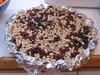
    Pie_weights
    Incidentally, the recipe calls for a pizza stone to heat up in the oven and for the pie to be baked on this stone. We did away with this, and the pie was a revelation, so unless you have a pizza stone lying about, don't bother with this step. While the crust was baking, I beat together the filling, and also put together a handy-dandy mise-en-place – look closely and you might even see the cayenne peeking out amongst the spices. I filled the hot crust with the filling and stuck the whole thing into a 300-degree oven, as per the recipe.
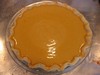
    Filled_crust
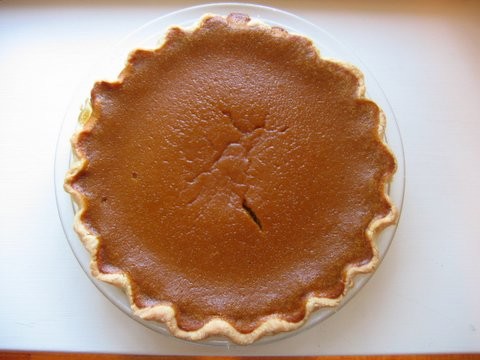
    If you're wondering, you guessed right: this is too low for pie-baking (unless your pizza stone does all the work?). After 40 minutes, I had to turn the temperature up to 325 degrees. The pie was done after another half hour. It had puffed up nicely, and still jiggled in the middle a bit.
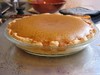
    Puffy_pie
    When it cooled, the filling sank down a bit and a little crack developed. I'm not obsessed with cracking pies – I think it gives them character.
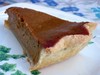
    Slice_6
    I was eating leftover slices of this until yesterday. It was so good, even cold and a few days old. The freshly-made pie had a bit of heat and warmth to it, but nobody guessed what the secret ingredient was. The squashiness of the butternut shone through beautifully, and the custard was firm but light.

    Butternut Squash Pie

    Yields 1 9-inch pie

    For the crust:
    1 1/4 cups all-purpose flour
    Scant 1/2 teaspoon salt
    2 tablespoons solid vegetable shortening, chilled
    5 tablespoons cold unsalted butter, in 5 pieces
    4 teaspoons beaten egg from 1 large egg

    For the filling:
    2 large eggs plus 2 egg yolks
    1 1/2 teaspoons vanilla extract
    1/2 cup dark brown sugar
    1/4  cup granulated sugar
    1/4  teaspoon fine sea salt
    1 1/2 teaspoons ground ginger
    1 1/2 teaspoons ground cinnamon
    1/2 teaspoon ground nutmeg
    Pinch cayenne pepper
    1 1/2 cups roasted squash purée, packed (see below)
    1 1/4 cups heavy cream

    1. For the crust: Combine flour and salt in food processor bowl, and pulse. Remove lid, scatter vegetable shortening and butter over surface, and pulse 5 or 6 times.


    2. Combine beaten egg and 3 tablespoons ice water. Pulse liquid into dry ingredients, continuing until mixture is evenly moist and dough looks curdy, 10 seconds. Turn onto work surface, and press firmly into disc, adding drops of water if dough feels dry. Wrap in plastic wrap and refrigerate at least 30 minutes or overnight.

    3. Roll dough into 15-inch round on lightly floured surface, and fit into shallow 9-inch pie pan. Trim and crimp edges. Refrigerate 1 hour. Meanwhile preheat the oven at 425 degrees.

    4. Line chilled pie pan with aluminum foil and fill with dried beans or pie weights. Bake 25 minutes. Remove foil, and bake until crust dries out and crimped edges begin to color, 3 to 5 minutes. Lower heat to 325.

    5. While crust bakes, prepare filling: combine eggs, vanilla, sugars, salt and spices in food processor, and process until smooth. Add squash purée, and process until smooth. With machine running, pour in heavy cream, and process to combine. Scrape filling into hot prebaked shell and until filling is set 2/3 in from perimeter and center still jiggles, about 30-40 minutes. Remove from oven, and cool to room temperature on rack. Garnish with whipped cream if desired. Serve.

    Squash Puree
    Yields 3 cups

    2 3 1/2- to 4-pound butternut squashes, scrubbed
    Grapeseed oil spray

    1. Heat oven to 350 degrees. Line a 12-by-15-inch rimmed sheetpan with aluminum foil, and spray with grapeseed oil. Trim off stem end, then cut through squashes horizontally where bulb begins. Reserve bulb for another use. Cut squash necks in two lengthwise. Slice into 1-inch sections and arrange on sheet pan.

    2. Bake, turning occasionally, until squash is tender and beginning to caramelize, 1 to 1 1/2 hours. Cool slightly, trim skin away with paring knife, and force flesh through food mill. Use immediately in pie or place in plastic container with lid, and refrigerate up to 4 days; freeze up to 2 months.

  • Cookies
    My third Sugar High Friday event feels like a momentous one, because it's combined with my very first Is My Blog Burning event! Two birds with one stone – I love it. Alberto of Il Forno and Jennifer of The Domestic Goddess, the originators of IMBB and SHF, respectively, joined forces this time around. Although I only had two days in New York between my vacation in France and leaving again for Thanksgiving in Boston, I made time in my schedule to bake cookies (I live a tough life, I know.).

    Last year, I clipped an intriguing recipe from the New York Times for buckwheat cookies. Melissa Clark had first tried them on a trip to Italy and after much wheedling, managed to extract a recipe for them from a cook in Piemonte. The recipe was badly translated and she had to go through several test batches to get the cookies right, but her efforts were worth it. These unassuming little biscuits are splendid, in an entirely understated way.

    The cookies don't look like much – the buckwheat flour gives them a dull, gray color. But they are tender little things that crunch pleasingly under your teeth and then melt. The buckwheat tastes dusty and almost otherworldly, while the salt sparkles gently in the background, bringing faint caramelly flavors to the foreground. I ate one, and then another and another. They are addictive. I usually give all my baked goods away – I can't seem to bear to eat much more than one piece of something before tiring of it. But these buckwheat cookies I might have to hoard. Not sure how much luck I'll have. So far everyone who's had one crinkles their forehead in wonder at what the odd-colored little cookie could be made of, and then reaches out a hand for more, please.

    The recipe is easy-peasy and fast. You beat together butter and egg yolks, then stir in regular and buckwheat flour, a bit of sugar, salt and baking powder to create a stiff dough. Clark instructs you to either put the dough in a pastry bag and pipe the dough into spirals, or form balls of the dough, using a fork to press the balls into rounds.
    Ziploc
    I combined these two ideas into one: putting the dough into a zip-loc bag, cutting off the tip to make my own pastry bag and then piping out what ended up looking like small turds onto a parchment-lined pastry sheet. These looked so unappetizing that I took a fork to them to make them look more respectable.
    Turds
    The dough softens swiftly, so this process got a bit sticky. Make sure you work fast.
    Then into the oven they go until they're faintly golden around the edges.
    Done_1
    I'll be using up the remaining buckwheat flour for waffles from the LA Times soon – stay tuned. In the meantime, thank you Alberto and Jennifer!

  • Gari
    Our vacation on the Cote d’Azur was lovely in many ways, but foodwise, it was nothing special. Oh sure, the cheese from the maitre fromager was lovely, the cracklingly fresh baguettes we bought almost every day were splendid and difficult not to wolf down in one go, and the gorgeously fresh and flavorful steaks we fried up at home one night were delicious, too. It’s, of course, no secret that the French have fantastic food at their disposal. But in terms of restaurants, we had little luck.

    A lunch in Aix-en-Provence made my airplane food the following Sunday taste delicious. Gloppy and stale-tasting potage aux legumes, followed by limp pasta in a watery sauce of tomatoes, olives and supposed anchovies, though there was nary a fish to be found therein, does not a glorious French lunch make. A dinner at a small and cozy place in Vieux Nice called L’Atelier was marred by terrible service and filets de rouget that neither Ben nor I could choke down due to their overpoweringly fishy flavor. The cafe in St-Paul-de-Vence where we stopped for lunch one day served up an amazing mustard sauce that I could have poured into a bowl and sipped on all day, but the pork chop it smothered was gristly and tough.

    Our only real success was at a tiny bistro called Au Petit Gari on Place Garibaldi, near the famous Cafe de Turin, where the oysters are sparkling and fresh. After a particularly harrowing parking spot episode, we staggered out of the car and around the square, trying to find a place to eat. We came upon a small restaurant, decorated kitschily with old-fashioned plates and ashtrays and kitchen utensils. Inside a group of women caroused happily at one table and a family tucked into their food at another. We had a seat and were promptly shown a menu on a large chalkboard toted around to us.

    To start, Ben and I shared a wedge of Camembert baked in the oven with purple potatoes, white wine, crisped breadcrumbs and toasted pine nuts. It was delicious – warm and cheesy and spiked with just anough wine and texture to make it interesting. Ben followed up with a pasta dish, while I had a piece of chicken that had been stuffed with a wonderful breadcrumb mixture flavored with parsley and capers. The chicken came with a mound of the homey mashed potatoes laced with olive oil.

    When it came time for dessert, we had no choice but to order the profiteroles that had been served to another set of diners and had brought a feverish gleam to Ben’s eyes. Our waiter asked us if we wanted one puff to share and two forks, or one puff each. Well, we’d just have one and share, of course. We’re not gluttons! The waiter winked and went off to the kitchen, only to return with one plate filled with two huge, freshly baked creampuffs, deeply-flavored vanilla ice-cream oozing out of each, and glossy dark chocolate sauce napped around the entire business. I’ll just go right ahead and admit that we practically licked the plate. As we wiped the chocolate sauce from our chops, the chef came out of the small kitchen with his warm jacket and backpack on and visited each table to thank us and say goodnight before going out into the chilly night.

    It was a lovely dinner – homemade and delicious and filling. The kind people who worked there made the evening even better. I should mention that it was good value, too. Our bill, with two glasses of wine, came to 46 euros.

  • We’re back! It was a perfect vacation. And how could it not be? When you have a view from your apartment window that looks like this
    View
    and drive to hilltop towns that look over the Mediterranean with succulent plants all around like thisEze
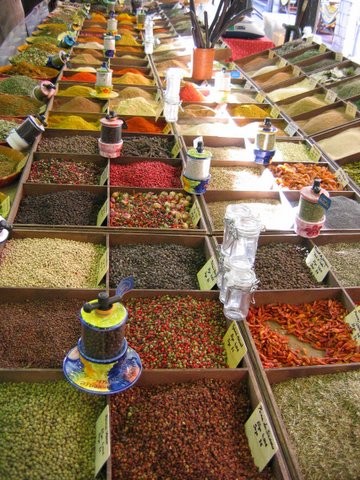
    and go to covered markets in seaside towns where you can buy oils and spices and herbs like theseMarket
    and see churches bathed in glorious sunlight like thisChurch
    and drink coffee with your darling while the sun sets over a choppy sea like thisSunset
    and drive up winding mountain roads until you get to a deserted and silent little town like thisPeille
    well, then how can you go wrong? You can’t, I tell you.

    And if you’re lucky enough to have a traveling companion who makes you laugh like this
    Image60Image61Image62
    then that is one fabulous vacation.