DSC_9422

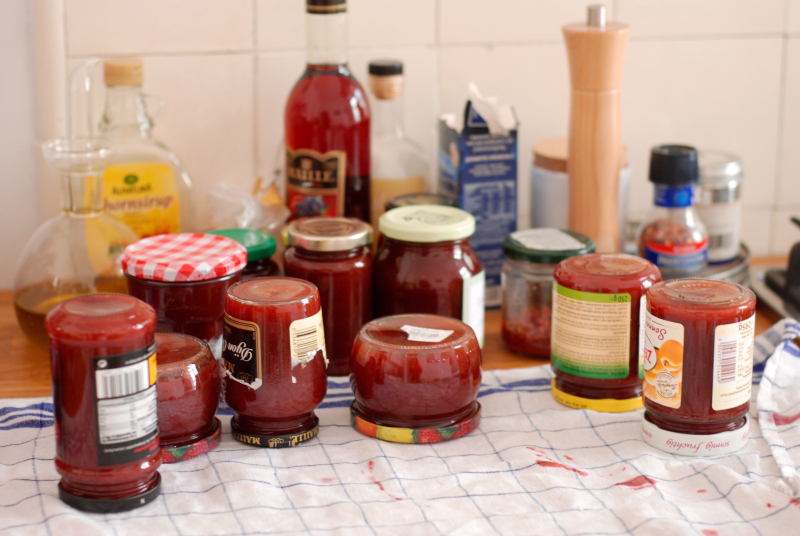
After lunch on Saturday afternoon, we spontaneously decided to go apple-picking with friends. But when we got to the U-pick orchard just outside of Berlin, we discovered that the apple variety we'd set out to pick, Pinova, wasn't ready yet. Other varieties of apples, pears, and plums were ready, so we contented ourselves with those. Now I have several kilos of each in my kitchen; the pears still need a few weeks of ripening, the apples are delicious and crunchy out of hand, but the plums, well, those have already been turned into jam. Quick work!

I love making jam – apple butter in falll, Seville orange in winter, blueberry-lime (make sure to reduce the sugar a bit) in summer – but this year, the cookbook work kept me from any jam-making. I figured I wouldn't much miss my little pots and jars in the pantry that much and contented myself with store-bought jams instead, but they were always too sweet and insipid compared to the things I made myself. (The jam I most regret skipping was the Seville orange marmalade, which when homemade is so incredibly superior to anything you can buy – even fancy, high-quality brands – that I have sworn to myself that even though our baby is due right before Seville orange season, I'm not going to skip it again this year. Wish me luck! I'm pretty sure I will be cursing this resolution in early February when I'm knee-deep in nipple cream and sleep deprivation.) So I'm back at the jam-making station now, easing myself in with Damson plums, a supremely satisfying and easy fruit to preserve.
DSC_9424

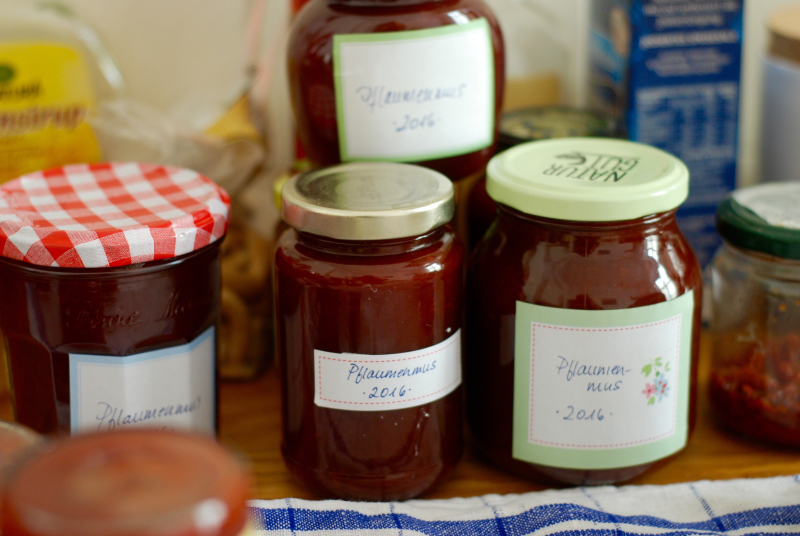
Damson plums are high in pectin, which means that when cooked with sugar they thicken and gel beautifully without any added help. They're also easy to pit, which makes them very appealing to work with, especially when you're confronted with 4 kilos of them after not even half an hour spent in the plum orchard. I turned half of my Damsons into Pflaumenmus, a thick plum butter spiced with cinnamon and cloves that is also known as Powidl in Austria and is an essential element in the German and Austrian kitchen. An easy and reliable recipe for Pflaumenmus is in both My Berlin Kitchen and Classic German Baking. Traditional Pflaumenmus is actually made without any sugar at all, but your plums must be very ripe and sweet for it to turn out nicely. Since the ones I had were still quite firm and sweet-tart, I used my recipe, which contains sugar.

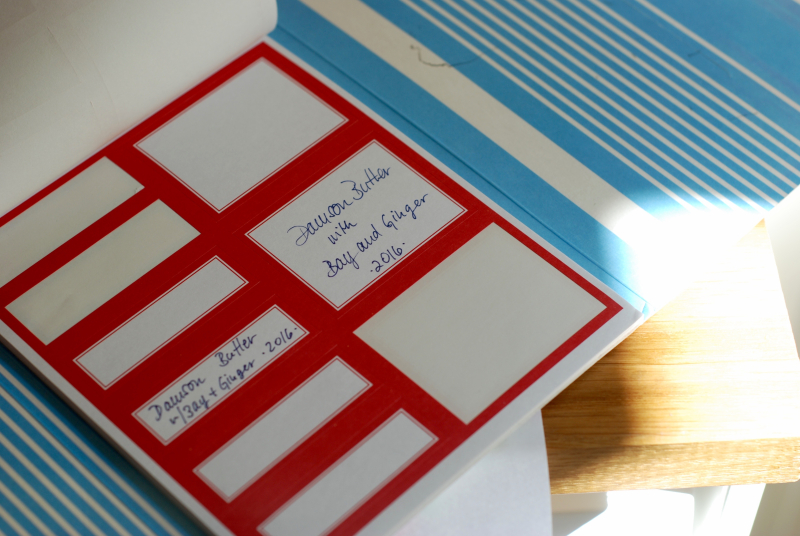
For the remaining of my Damsons, I turned to a recipe from Kevin West, the author of Saving the Season. West cooks his Damsons with bay leaves and ginger first, then forces them through a sieve (I used an immersion blender instead), adding the sugar and lemon juice only at this point before finishing the cooking. West is a genius with flavorings; he seems to have an uncanny sense of which herbs and spices pair best with fruit to bring out their best flavors. To my taste, his jams are often too sweet, so I reduced the sugar in the Damson butter, but you might find you prefer a sweeter jam, as he does. The ginger and bay give the plum butter a gentle fillip of spice and savoriness, but not too much of one. This is still a fruit butter that will do gloriously on a piece of morning buttered toast.
DSC_9432

As soon as the pears are ready to go, I'm going to be turning to this fantastic and inspiring little book for my next batch of fruit butter, a silky concoction of pears, apples and maple syrup. I'm trolling the markets for the season's very last plum tomatoes so I can make Kevin's savory tomato jam with smoked paprika (!). And like I said, I'm counting the weeks until Seville orange season. I can't wait to have a pantry full of homemade treats again.

Note: This post includes affiliate links and I may earn a commission if you purchase through these links, at no cost to you. I use affiliate links only for products I love and companies I trust. Thank you.

Kevin West's Damson Butter
Adapted from Saving the Season
Note: If you would prefer to preserve your Damson butter the American way, once the jars are filled and tightly closed, process them in a boiling water bath for 10 minutes. Marisa McLellan is an excellent resource on this subject. I do not process any of my jams in this way. The cooking time, the relatively high sugar levels, the high acidity of the fruit, the spotlessly clean jars, and the upside-down cooling method, which gives the jars an airtight seal, are enough for me and all European jam-makers I know.

4 pounds Damson plums, pitted
1/2 cup water
2 bay leaves
1-inch piece of ginger, peeled
2 cups sugar (the original recipe calls for 3 1/4 cups)
1 1/2 tablespoons lemon juice

1. Put the fruit, water, bay and ginger in a large, heavy pot. Bring to a boil over high heat, then reduce heat to low and simmer, covered, for 30 minutes, stirring occasionally.

2. Take the pot off the heat and remove the bay and ginger (discard). Using an immersion blender, purée the plums until smooth. Add the sugar and lemon juice and stir well.

3. Bring the mixture to a simmer over medium heat, then reduce to low and simmer, uncovered, for 15 minutes, stirring. Take the pot off the heat and ladle the hot butter into spotlessly clean or sterilized jars. Immediately cap the jars and turn them over upside-down to cool completely. The jars will keep, unopened, for a year. Once open, the Damson butter should be consumed within a few weeks.

Save

Save

Save

Posted in , ,

40 responses to “Kevin West’s Damson Butter with Bay and Ginger”

  1. Gerlinde@Sunnycovechef Avatar

    It is so nice to hear from you again and congratulations on the new baby. Oh, how I remember Pflaumenmus from my childhood days on the farm in Germany. The woman in the village would cook the Pflaumenmuss in large cooper kettles . The photo of your jars of jam reminds me of my mother’s jars. They looked just like that. I miss her so much.
    I can’t wait to get your Classic German Baking book, I will give it as a present to family and friends here in the States.

    Like

  2. Sue Lovegren Avatar
    Sue Lovegren

    Oh Luisa,
    What a beautiful post! This is a prime example of why my daughter and I enjoy your blog so much. And you’ve made it all look so easy. Honestly this is very inspiring!
    Thank you also for introducing us to Kevin West and Anja Dunk. I’m already thinking Christmas presents of jam and jam making books and Classic German Baking books. 😉
    Good luck with that Seville orange marmalade. But don’t forget, your health and the baby come first!

    Like

  3. Emily Avatar

    These look delicious! Love that they’re not too sweet. The savory tomato jam sounds really interesting, too. It’s become such a popular burger topping in the U.S., instead of ketchup.

    Like

  4. Dani Avatar

    I’ve only just started getting into making jam and I love it! So much tastier then store bought 🙂 I’ve been eyeing your plum butter off in ‘My Berlin Kitchen’ for a while now, just need plums to come into season here and I’ll be stocking my pantry. Also love a good tomato chutney 🙂 Thanks for sharing x

    Like

  5. Liz Avatar
    Liz

    Hi Luisa,
    I’m so nervous about jam making. Do you have to process the jars in order for them to keep? I see that in your picture you are reusing jars–I do the same, but worry about the seal.
    Thanks!

    Like

  6. Liz Avatar
    Liz

    Of course I see your note after I post. Sorry! I guess I need to take my teacher-self off to bed.

    Like

  7. Luisa Avatar

    Thank you, Gerlinde, on all counts!

    Like

  8. Luisa Avatar

    Aw, lovely, I hope you guys enjoy making jam!

    Like

  9. Luisa Avatar

    Don’t be nervous! There’s a lot of fear surrounding canning in general in the United States, but jam-making is really a different kind of beast from canning/bottling/preserving. The sugar, the long cooking time, the high acidity of the fruits, the spotlessly clean jars (sterilize them, if you prefer!), plus the inversion cooling method all lead to perfectly safe jam. No European jam-maker uses the water-processing method to make jam. Have fun! As for the jar reusal issue – the glass jars aren’t the problem, it’s the lids that could eventually get compromised. I use my own judgment here; if the lids have been through more than a few rounds of jam-making and are visibly damaged, I discard them (and their matching jars) or use them for other things like spice storage or vinaigrette.

    Like

  10. Mary Pisarkiewicz Avatar

    Oh so fun! Although not a easy process and it is well worth it! YUM

    Like

  11. Allyson Avatar

    I wish I had a pantry full of homemade treats. Perhaps this will be the year. As amazing as this plum butter sounds- and it does sound amazing- I’m particularly interested in the fact that Europeans don’t preserve by water bath? This is fascinating.

    Like

  12. Mary @ LOVE the secret ingredient Avatar

    Nothing compares to homemade preserves. I didn’t make much this year either though and I will definitely begin to miss it more as winter creeps up and I’m left with only memories of the delicious summer fruits.

    Like

  13. Luisa Avatar

    Not jams, no. There’s no reason to.

    Like

  14. Victoria Avatar
    Victoria

    Can you recommend a recipe for Seville orange marmalade? Thanks!

    Like

  15. marlies Avatar
    marlies

    Hi Luisa,
    congrats on the new baby! I really enjoy your posts (and also Instagram).
    I have a quick question: where in Berlin do you get Sevilla Oranges? I’ve never come across any…
    Austrian Zwetschgenröster is also lovely (for with Kaiserschmarrn) and quick to make (either on the stove or in the oven). In Austria “Powidl” is way thicker than German Zwetschgenmus, it usually is almost blackish and pastelike.
    I’ll definitely try your recipe with bay leaves and ginger – this sounds just delicious. Thanks!
    (And I’ll have some Zwetschgenknödel soon :))

    Like

  16. Luisa Avatar

    I have found them at the Karl-August-Platz Wochenmarkt and (from the same vendor) at Klausener Platz. The window for finding them is verrrry small – usually only about 2 weeks. In late January or early February, depending on the weather.

    Like

  17. marlies Avatar
    marlies

    Thanks!

    Like

  18. Victoria Avatar
    Victoria

    Sad I didn’t start making this earlier so that I might’ve had a chance to reach you before midnight in Germany. Oh well! My damsons were quite ripe and so I added just one cup of sugar and simmered to dissolve and tasted, and it’s plenty sweet for me. However, not being a regular jam maker, I’m wondering if it will still be safe or if the two cups you used were the minimum for preserving??? Would LOVE your input whenever you get a chance!

    Like

  19. D Avatar

    If you are at all nervous you can also go one step further (as Luisa may have described in her first marmarlade post? I forget where I first read it). I wash my jars and then put them in a 120-150°C oven for 15-20mins and put the lids, ladle,a fork and metal funnel in a pan of water that I simmer for a similar length of time. When the jam is ready I ladle the hot jam into hot jars (on a wooden chopping board so they don’t crack), fish the lid out with the fork and screw it on. Then I tip them like Luisa does.
    With lids so long as they can maintain a seal you’re fine. If they’re dented or rusty they’re no good and sometimes the rubbery seal ages and isn’t flexible anymore. If you like your jars you can often buy more lids. I have a wholesaler near me that sells lids and jars separately as most will as companies often have customised lids). The lids age much faster with vinegar passed preserves like chutney. Otherwise just collect them off friends and family or from other jar based foods like lazy day pasta sauce and peanut butter.
    Give it a go on a small batch!
    Such good timing Luisa! I just made 14 jars of new grapefruit marmarlade (I’m told it’s actually a kind of orange)
    The suggestions of recipes books to try with interesting combinations to try have whet my appetite so much I had to start making dinner! Lovely to hear your news too!

    Like

  20. D Avatar

    Maybe it was Delia Smith and Luisa combined.
    Canning by water bath for jam makes me curious. As an efficient cooking time is best for flavour (hence why small batches are good) does that suffer at all with the extra processing time for canning? Any opinions from those who’ve tried both?

    Like

  21. Luisa Avatar

    It’s not going to keep as long – the less sugar you use, the less you’ll be able to keep it. And this is a relatively quick-cooked jam, which also lessens its keeping time. As long as the jars are airtight, put them in a dark part of your pantry, but consume within 6 months. Once opened, make sure to eat them within a few weeks – and store in the fridge.

    Like

  22. Katie Hestead Avatar
    Katie Hestead

    Hi! I wanted to pass on this article that maybe you’ve already read, but I thought you would appreciate. Congratulations on the new baby, as well!
    http://www.saveur.com/what-makes-a-good-recipe

    Like

  23. schlachtplatte Avatar

    I’m curious, why should long cooked jam stay fresh longer? Shouldn’t all bacteria etc. be dead once you reach boiling point? I always let my strawberry jam cook for no more than 5 minutes and it keeps well over 6 months. Also, I think the best rule of thumb is: if you open the jar and it does not smell weird/is moldy, then it’s good to eat, even after 3 years. This applies to all food, e.g. store bought yoghurt keeps well over the best-before-date.

    Like

  24. Christine Jordan Avatar
    Christine Jordan

    Your damsons must be a different thing to our English damsons. Small, oval and nearly black, they definitely do not pit… at all….
    Conversations among local jam makers at this time of year usually revolve around how to deal with the stones. I think pretty nearly everyone cooks their damsons whole then we have various methods of removing the stones from the pulp before adding sugar. One friend says he has a quick go at removing the stones, but doesn’t spend too long at the job, his jam comes with a hazard notice!

    Like

  25. Lindsay | Please Pass the Peas Avatar

    Luisa,
    Do you use dried bay leaves or fresh? Thanks!

    Like

  26. Katie Avatar
    Katie

    Hi Luisa,
    Do you have a recipe for Pflaumenmus? I grew up eating that stuff but never knew the name for it! My dad would bring me back jars of it to the US after he’d go to Europe on business trips.
    Thank you!

    Like

  27. Karen Simon Avatar
    Karen Simon

    I’m curious to know if your method of canning jam would also work with blackberry jam. I’ve only canned with the water bath method. I just dicovered your blog – it’s great!

    Like

  28. Dennie Raviv Avatar
    Dennie Raviv

    Hi Luisa
    I reached your blog thru Smitten Kitchen and so happy that I did. I learned a very similar canning method from a British friend here in Israel, but every time I would look on a US website for “confirmation” they would always say don’t ever reuse lids, jars and always use water bath etc. etc. I have been safely preserving Mango Chutney for years with the “European Method ” using up all the Dijon and Braille jars I accumulate and have been afraid not to refrigerate them, though leave a few out every year and they are always fine. Good luck with blog, new baby etc. I will happily subscribe .
    Dennie

    Like

  29. Luisa Avatar

    In my first book, My Berlin Kitchen.

    Like

  30. Luisa Avatar

    Yes. Thank you!

    Like

  31. Luisa Avatar

    Welcome and thank you!

    Like

  32. Francesca Avatar
    Francesca

    Dear Luisa,
    I had just made two batches of your Pflaumenmus and thought I was done with plums for this season, when you came with this post and I was tempted by the peculiar combination. But I told myself no, enough plum butter! And then a neighbor called wanting to give me plums because she just harvested her tree and had way too many. I thought that was a sign! 😉
    So I did make the new damson butter and I am glad I did. It didn’t turn out quite as firm as the pflaumenmus so I decided it might make a good jam for a crostata.
    Of course, given all the plums I had on my hands, last week-end I made your Pflaumenkuchen as well. Someone stop me!
    Thank you so much for being such an inspiration and congratulations for the growing new life!
    p.s. all this talk about plums made me think of Susanne Vega’s “My Favorite Plum”. Such a poetic song!

    Like

  33. Margit Van Schaick Avatar
    Margit Van Schaick

    So wonderful! Luisa, this is so inspiring. I have q question about gardening? Do you have a kitchen garden? If so, I would love to hear about what you grow. I’m very interested in small kitchen gardens.

    Like

  34. Luisa Avatar

    In my dreams, I do! In reality, I have rosemary, marjoram and sage on my balcony. Sigh. 🙂

    Like

  35. Jess Avatar
    Jess

    I happened upon this post and the following day I bought a beautiful basket of Damson plums at the farmers market. I made this recipe on a lark. And I have to tell you – it’s AWESOME. My boyfriend and I are not really into jam/preserves but both of us declared this the most delicious jam ever. Thank you so much for sharing the recipe. Now I have to find some more early-autumn plums …

    Like

  36. Luisa Avatar

    So wonderful to hear this; thank you!

    Like

  37. marlies Avatar
    marlies

    Luisa, thanks again for the great recipe, it worked brilliantly even with less than great damsons.
    I’d absolutely recommend making this – so if someone reading the comments is still unsure whether to go for it, I’d say: do it!!

    Like

  38. Caterina B Avatar

    I just read one of your posts on Facebook on a site called “The German Way” I think that was it, anyway.
    After reading about a German Breakfast, besides being hungry now, I just realized that you are the author of the book “My Berlin Kitchen,” which I read last summer. I loved the book and made the pflaumenkuchen which by now, of course, I had forgotten about. We have a bush/tree that sometimes give us good plums. It has taken weeks and weeks this year for them to ripen enough to use. I have a bowl of our Italian prune plums sitting on my island. I must make that kuchen again today!
    I think I will reread your book, too. I do remember that it awakened in me a long buried curiosity about Berlin and Germany, in general. Thanks!

    Like

Leave a comment